


LITHUANIA CALLS TO END DE FACTO DISCRIMINATION AT THE CONFERENCE ON PEOPLE WITH DISABILITIES
"Just like everyone else, persons with disabilities can be efficient members of the society if they were only provided with the opportunity", said Ms. Violeta Toleikienė, Director of the Social Inclusion Department of the Ministry of Social Security and Labour, addressing the 6thsession of the conference of the States Parties to the United Nations Convention on the Rights of Persons with Disabilities taking place in New York on 17-19 July 2013.
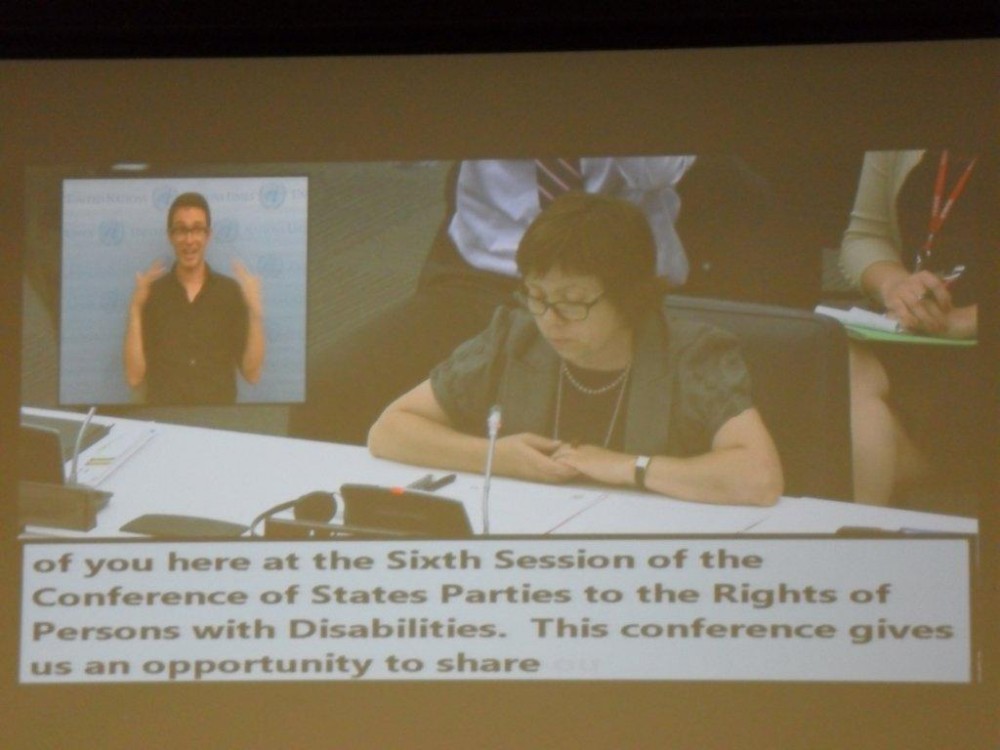
Statement by Ms. Violeta Toleikienė,
Director of the Social Inclusion Department of the Ministry of Social Security and Labour of the Republic of Lithuania,
at the 6th session of the conference of the States Parties to the United Nations
Convention on the Rights of Persons with Disabilities
17-19 July 2013, New York
Check against delivery
Dear Mr. Chair,
Ladies and gentlemen,
Dear colleagues,
I would like to start with sincere greetings to all of you, gathered here to the 6th session of the conference of the States Parties to the United Nations Convention on the Rights of Persons with Disabilities. This conference gives us an opportunity to share our experiences and to remember our common responsibility in implementation of one of the most significant international treaties of human rights.
Lithuania aligns itself with the statement made by the European Union and fully subscribes to and actively supports the full participation of civil society representatives at this meeting.
Since 1 July 2013 Lithuania is holding the presidency of the Council of the European Union. De facto antidiscrimination is one of our presidency’s priorities. In my opinion, European Union assumed greater obligations in the area of the rights of persons with disabilities by ratifying the Convention and by becoming a State Party. There is no doubt, that the EU legislation, programmes and strategies help to implement practically the provisions of the Convention not only in the European Union, but on the national level as well. Therefore I would like to share with you our national experience on the implementation of this Convention.
In 2010 Lithuania ratified the Convention of the Rights of Persons with Disabilities and its Optional Protocol and took actions to implement the provisions of the Convention by improving and ensuring the quality of life of persons with disabilities.
The legal framework developed in Lithuania creates the institutional mechanism of implementation of the Convention covering both the public sector and non-governmental sector. The programmes of social integration and anti-discrimination of persons with disabilities have been successfully implemented, aiming at enhancing and ensuring the rights and possibilities of the disabled to fully participate in political, social, cultural and economic life of our country. The primary report on the implementation of the Convention by theRepublicofLithuaniawas presented to the United Nations Committee on the Rights of Persons with Disabilities last year. We plan to nominate the Lithuanian candidate for the election of the members of the Committee on the Rights of Persons with Disabilities in 2014.
However, today I would like to focus and elaborate more on one of the issues of our meeting which is particularly relevant to our country, namely, full and independent life of persons with disabilities and their inclusion into community. Just like everyone else, persons with disabilities have various competences and majority of them can be efficient members of the society if they were only provided with the opportunity, like adopted to their needs education, work place or public life.
As it was mentioned before, Lithuania has implemented a number of programmes and measures aiming at the social integration of persons with disabilities and the improvement of quality of their life these include, provision of technical assistance measures and social services, adaptation of accommodations, payment of targeted compensations, financial support for disabled students, promotion of engagement and employment, as well as implementation of the professional rehabilitation programmes.
I would like to note that currently Lithuania is in progress of drawing up the National Programme aiming at Children’s with Disabilities, Removed from Parental Care, smooth replacement from the institutional guardianship to the services provided by family and community. Politicians, representatives of non-governmental organisations and public authorities actively participate in this process.
By this programme we seek to establish a consistent and well-structured system of assistance and services which would create possibilities for each disabled child, removed from parental care, and for disabled adult to receive personalised services and necessary assistance in order to improve their participation in a public life.
CRPD puts emphasis on the importance of the family and its role in the process of social integration of persons with disabilities. Therefore, we seek that each disabled child could be provided with opportunities to grow up in a safe environment which would be favourable to his or her development. It could be family of biological parents, foster parents or guardians, and in special cases, other environment which would be as close to the family conditions as possible.
At this point the preventive measures aiming at solution of family problems are of particular importance. First of all, we must do everything for children to grow in their family, therefore helping these families, in order to avoid child’s placement within the children care system, is an absolute necessity.
The Convention requires conditions for persons with disabilities to maintain maximum independence. We seek to create possibilities for independent or partially independent persons with disabilities to live in their home receiving non-hospital services by their municipalities and communities. We have stressed the right of person with a disability to freely choose a job, work in an adopted to his or her needs workplace as well as the right to professional rehabilitation, professional training and the right to assistance when looking for a job.
Nevertheless, it should be noted that for some people with certain disabilities institutional care is often the only possible help due to the nature of their disability. Thus, proper infrastructure of care home, qualified employees and ensuring of the most necessary assistance such as nursery, psychological assistance, is of particular significance.
Dear colleagues,
I am happy for the opportunity to take part in the event where we can share our experience, plans and ideas in order to ensure the rights and better life for persons with disabilities.
I would like to wish substantive and interesting debate during the conference.
Thank you for your attention.
