


Lithuania's statement at the 61st session of Commission on the Status of Women
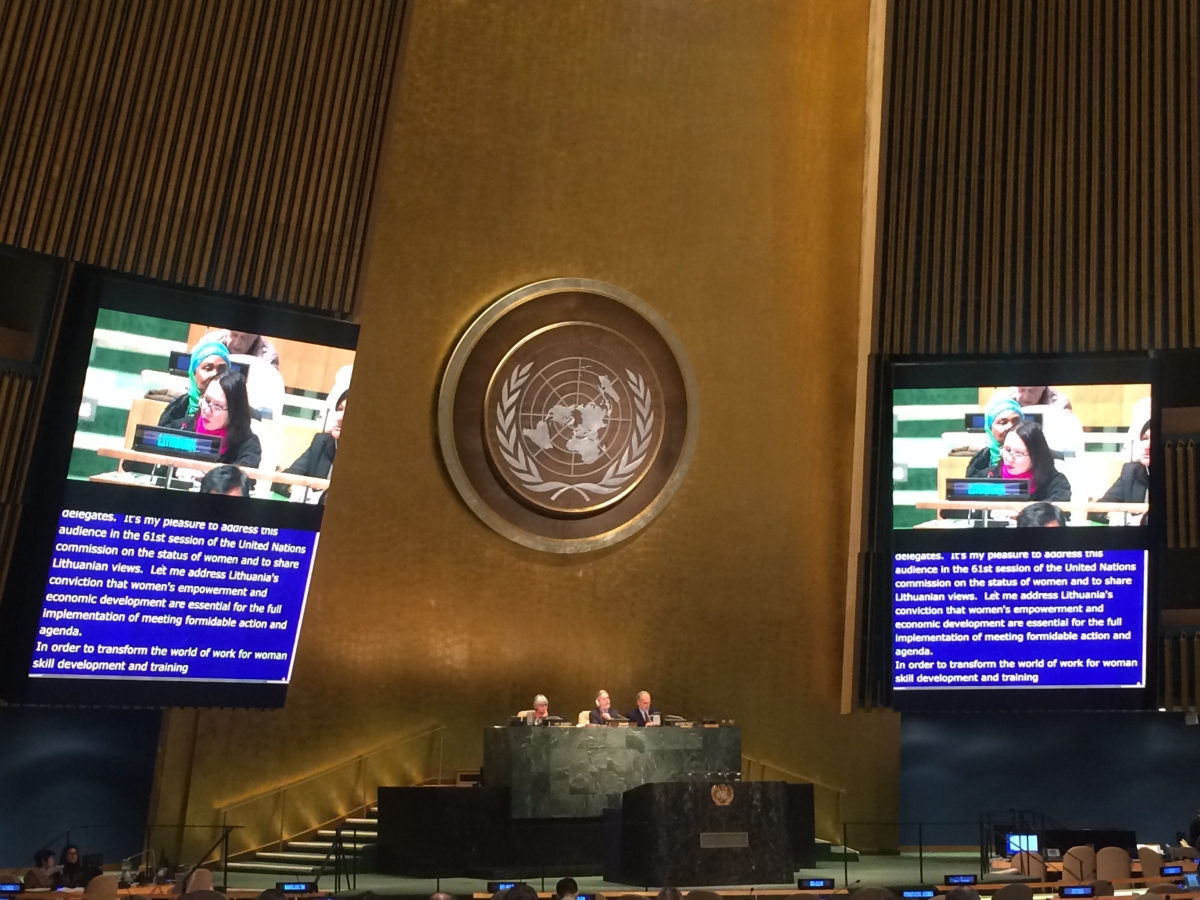
Honourable Chairperson, Distinguished delegates, It's my pleasure to address this audience in the sixty first session of the United Nations Commission on the Status of Women and to share Lithuania’s views. On the outset let me stress Lithuania’s conviction that women’s economic empowerment and economic independence are essential for the full implementation of the Beijing Platform for Action and of the 2030 Agenda, in particular, SDG (Social Development Goal) 5 on achieving gender equality, and SDG 8 on inclusive and sustainable economic growth, full employment and decent work for all.
In order to transform the world of work for women, it is important to implement legal and policy frameworks across women‘s life cycle; support their access to skills development and training in such spheres as science, technology, engineering and mathematical education, digital literacy; strengthen women’s leadership and decision-making.
National legislation ensures de jure equal rights and equal opportunities for women and men in all areas, including labour market, education, science, social protection. Let me note that gender pay gap was 15.6 for the year 2015 in our country. Commitments of the Beijing Platform for Action and of international conventions have been transposed into national laws and policies, such as the National Programme on Equal Opportunities for Women and Men, which aims to promote equal opportunities in employment, to balance participation in decision-making and to promote gender mainstreaming to education, science, health, culture. It targets to address gender pay gap, gender-based occupational segregation issues and promote women’s entrepreneurship in rural areas. The measures, such as training on gender equality planning at work, awareness raising campaigns in cooperation with social partners helps to achieve high women’s employment rates, for example, it stood at 74.1 per cent in 2016.
Recently, Lithuania adopted a legislative package called “New social model” establishing modernized regulations of industrial relations, social security and the pension system. Reconciliations of family and work relations is one of the priorities of the reform, which aims to make labour market more flexible, while increasing security through the unemployment insurance system, active labour market policies and improved social dialogue.
We consider important to promote equal sharing of care and household responsibilities by ensuring the availability of quality childcare and care services for dependents. More and more men are taking parental leave, in 2014 – 21 per cent.
As UN Women's Executive Director Phumzile Mlambo-Ngcuka indicated, there are challenges, but there are the solutions. One of the challenges is violence against women, it impacts women’s employment, health and economic dependence. Therefore, estimating the economic costs of gender-based violence is important for better informed decision-making and policy development in the changing world of work.
Madame Chair,
Lithuania strongly supports the gender-responsive implementation of the 2030 Agenda, acceleration of women‘s and girls’ economic empowerment, and the need to ensure equal opportunities for both men and women while realizing their rights.
Thank you for your attention.
Delivered by Ms. Eglė Radišauskienė, Vice Minister for Social Affairs and Labour
