


Lithuania's statement at the UN General Assembly special session on world drug problem (UNGASS 2016)
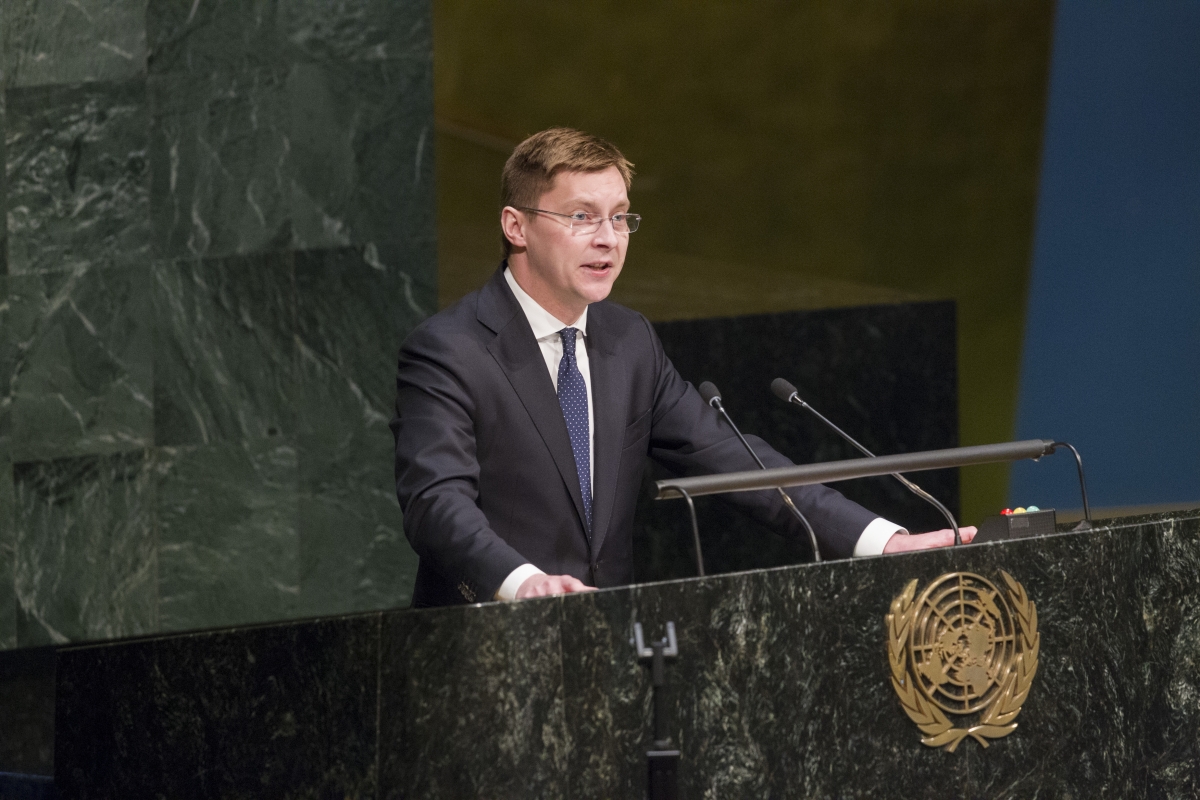
As delivered by H.E. Mr. Juras Pozela, Minister of Health of the Republic of Lithuania Mr. (Madam) President, Excellencies, Ladies and Gentlemen, It is a pleasure to join you and the other distinguished delegates here today. Lithuania considers this United Nations General Assembly Special Session on world drug problem an important opportunity for the international community to review what has been achieved and to assess what remains to be done in order to effectively address the world drug problem. Therefore, Lithuania, together with all the European Union Member States, has been extensively engaged in the UNGASS preparatory process, providing contributions and defining our common position. We fully align ourselves with the statement delivered by the European Union and its Member States.
While recognizing the progress made in solving the world drug problem, Lithuania regrets that this problem remains a major challenge for the international community and it still requires an effective and increased bilateral, regional and international cooperation on the basis of the principle of common and shared responsibility. We also do believe that there is a strong need to establish relevant and effective cooperation among all the UN entities in order to develop effective drug policy oriented towards human rights and public health and based on scientific evidence and best practice.
Drug use is a public health issue. There is a need for an improved understanding of addiction and the growing recognition of it as a chronic but treatable multifactorial health disorder. This is why we need to balance our drug policies towards a human rights and public health based approach. We need to put people first when developing responses. We also have to ensure that a broad range of drug demand reduction services provide approaches that serve the need of vulnerable groups and are differentiated on the basis of scientific evidence so that they respond best to the needs of those groups.
We totally agree with the need to better implement the approaches of the existing Drug control treaties, Political Declarations and the Universal Declaration on Human Rights that require a balanced, comprehensive and integrated approach where health and welfare is at the core of drug control policy, where human rights are promoted and the principle of proportionality is applied. Lithuania is convinced that success depends upon the political will and ability of States to implement evidence-based policies and practices in line with the conventions.
Under the drug control conventions, State Parties have committed to ensuring that access to controlled narcotic and psychotropic substances to relieve pain and suffering is not unduly restricted, while recognizing the need to prevent abuse, misuse and diversion.
Lithuania strongly believes that human rights are an integral part of any response to the drug problem. Therefore, we consider that death penalty for drug-related offences contradicts to international law and the spirit of the UN drug control conventions. Lithuania as all the European Union member states regrets that the prohibition of the death penalty for drug-related offences has so far been excluded from the Outcome Document despite continuous calls from the EU, several States, UN agencies and civil society organizations.
We are facing now numerous new challenges, such as new psychoactive substances, new trends on illicit production and trafficking routs, we also observe the rapid evolution of a new market - sale and purchase through internet, misuse of legal medicines is spreading in many countries. Lithuania considers that these challenges faced in solving the world drug problem require responses based on the cooperation of all stake holders at the national, regional and international levels. Given the strong linkages between supply and demand, it is important that the justice and health sectors collaborate on solving drug problems.
We would like to take this opportunity to reiterate the importance of the engagement of civil society and scientific community in the development, implementation and evaluation of drug demand reduction policies, both at the national and the international levels. Here at the UNGASS, Lithuania is proud to be officially represented by several NGOs representatives participating as a part of Lithuanian delegation.
Ladies and Gentlemen,
UNGASS provides an important opportunity for all of us to develop and implement science- and evidence-based drug policies, promoting evidence-based prevention, public health interventions, including treatment, risk and harm reduction measures, proportionate sentencing, as well as strengthening operational cooperation against organized crime. Research evidence shows clearly that harm reduction approaches are beneficial for health, because they prevent overdose and transmission of diseases like HIV, hepatitis B and C. Also, it has tremendous effects of reducing criminality rates in communities. Therefore, Lithuania takes the leading role in spreading knowledge and expertise on modern harm reduction and biological, psychological and social treatment approaches for dependent persons and families affected across the region.
It has been a long road leading to the UNGASS. But the hard work is still not over. We all are engaged to put our efforts achieving common objectives addressing the world drug problem through strengthened national, regional and international cooperation. In Lithuania, we intend to look carefully into new ideas brought in the UNGASS outcome document and to study what conclusions we can make nationally, what changes we need to introduce into our drug control policies.
Thank you for the opportunity to address you today.
