


Lithuania's statement at the UN Security Council open debate on children in armed conflict
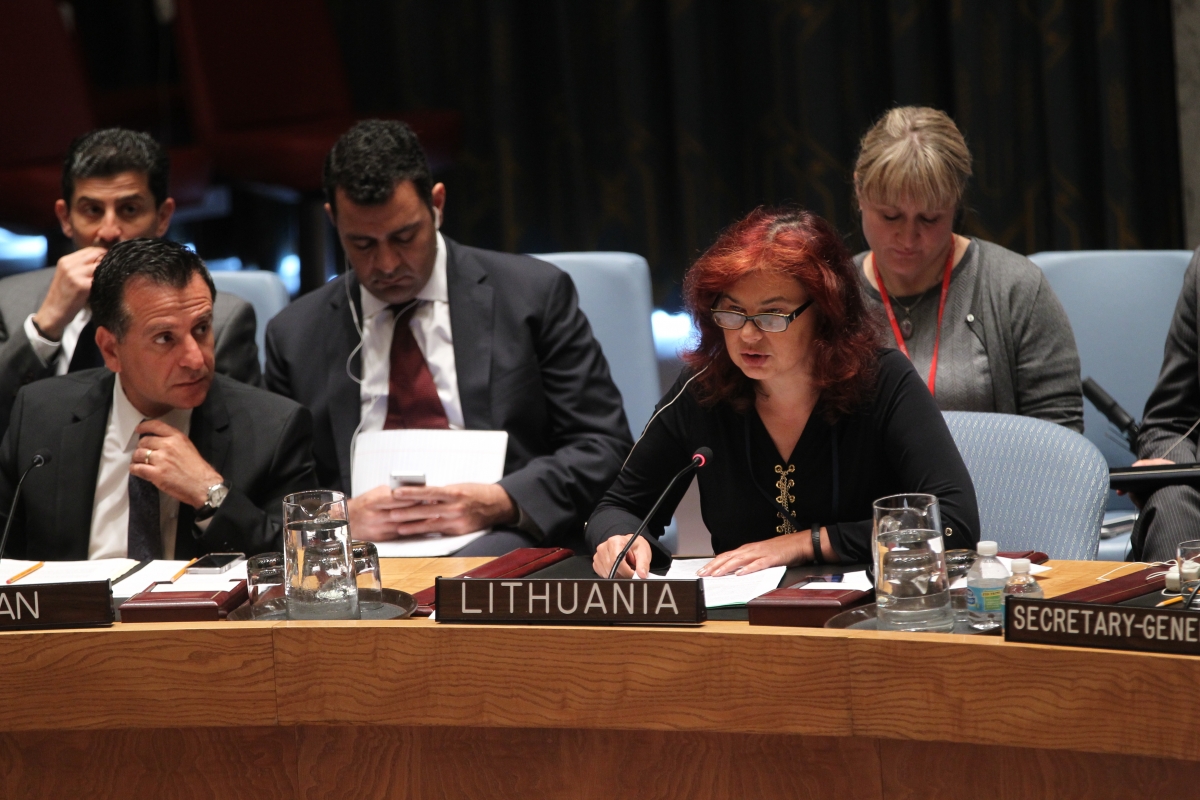
Mr. President, I would like to thank Malaysia for holding this open debate. I also thank the briefers for their presentations. Lithuania aligns itself with the statement to be delivered on behalf of the European Union. Armed conflicts continue to have a horrific impact on children. Recruited as child soldiers, stunted by malnourishment and starvation, forced to witness the death of their parents and siblings, abducted and turned into suicide bombers, sold on slave markets like cattle - children in conflict zones are denied even the most basic of human rights.
Granted, over the past years, positive steps have been taken on the protection of children in armed conflicts, and we express our appreciation for the dedicated and passionate work of SRSG Leila Zerrougui to this effect.
Incorporation of child protection provisions into peace-keeping mandates, the inclusion of crimes against children among sanctions designation criteria, child protection advisers, national action plans, the campaign Children Not Soldiers - all of these have all been important developments.
And yet, countless children across the Middle East, in Africa and even in the middle of Europe continue to suffer from conflict-related violence.
In eastern Ukraine, foreign aggression and the reign of lawlessness imposed by the illegal militants have caused massive displacement, impacting primarily the elderly and the children. The latter account for more than 161,000, or some 18 per cent, among the registered IDPs, while the total number of children affected by this conflict amounts to 1.7 million. Restricted access to medical services and education, life in temporary shelters and basements of damaged buildings and continued psychological trauma are the daily reality for those children. Child soldiers have been recently spotted by OSCE monitors in the ranks of the illegal militants.
In Syria, the worst humanitarian crisis of our time, 7.5 million children are in need of humanitarian aid, 2.6 million are deprived of education opportunities, and close to 2 million are living as refugees in neighboring countries.
Across Yemen, ongoing conflict is having a huge impact on children as well. 9.4 million Yemeni children require humanitarian assistance. 3,600 schools or 76 percent of the country’s total have closed due to insecurity, and 1.83 million children lost over two months of school. More and more young boys are seen manning checkpoints and involved in armed groups.
Yesterday’s statement by UNICEF chief on the atrocities in South Sudan- boys castrated and left to bleed, girls as young as eight gang raped and murdered, an estimated 13 000 children forced to participate in a conflict not of their making-reminds once again of the darkest depths of inhumanity humans can reach.
These are but a few cases where conflicts are taking a heavy toll of children’s lives. The list of such conflicts, however, is devastatingly long.
Mr. President,
Abductions of children are being increasingly used by armed groups and terrorists as a tactic of war, to impose their murderous rule and to target particular ethnic or religious groups. The Chibok girls abducted by Boko Haram in Nigeria, the abduction of Kurdish boys and Yezidi children by Dae'sh are among the best known recent atrocities and crimes against humanity. LRA, which this Council discussed only last week, is known to have abducted some 30,000 children, boys and girls, some as young as six.
Abducted children are forced to commit rape and torture, are forced into regular combat to kill, often blurring the lines between the victim and the perpetrator. Dae’sh, known for its exceptional wanton brutality, has been widely reported to turn abducted girls, some as young as ten, into sex slaves, sold and resold on slave markets, some as many as twenty or so times.
It is hard to find the right words to describe the psychological trauma and the impact on children’s minds in such situations. Over time, some of those children turn from victims into victimizers, as was the case of Dominic Ongwen who was abducted at the age of 14 on his way to school and later became a notorious LRA commander.
Former abductees face tremendous challenges of reintegrating into normal life, and are often shunned and rejected by their own families and communities, especially former girl soldiers and repeated rape victims.
A recent article by a photojournalist Marc Elisson provides a telling story of several former LRA girl child soldiers, including a girl called Mary, who was abducted before she was 10 and forced to become a rebel “wife” at the age of 12. No longer a child soldier, she is rejected by her own community. “If she comes back to live, people have said they will burn her in our hut alive”, says Mary’s mother.
No doubt it is a story common to many former abductees and child soldiers, who suffer ostracism and exclusion because of their past. Some of them even wish for the time they were wielding the gun as child soldiers, missing the false sense of empowerment it provided over the lives of others.
Today such worrying signals are emerging from Central African Republic where the lack of options and opportunities to reintegrate into civilian life may be pushing some of the released former child soldiers back into the hands of armed groups.
While the release of children is of utmost importance, it is no less important to acknowledge that release must be accompanied by comprehensive, creative programmes aimed at addressing the profound damage inflicted upon the children, combining measures of reintegration, training, livelihood opportunities, psychosocial assistance, and community education. The role of civil society, NGOs and community leaders, including on tackling the stigma carried by such children, is very important.
We must remember to treat children as victims first, not as perpetrators. We welcome in this regard the steps taken by Government of Chad by signing a Protocole d’Accord with the United Nations regarding the handover of children associated with armed forces or groups to child protection actors. Such protocols could be a valuable tool for child rehabilitation.
Mr. President,
As mentioned in the recent report, accountability for violence against children remains far too rare, even in countries that have criminalized the recruitment of children. Protection of children from serious crimes and preventing such crimes from being committed go hand in hand with tackling impunity and ensuring that the perpetrators are held to account.
In this context, we welcome the progress made in fighting impunity in the DRC, where 61 individuals, including 5 leaders, have been subject to arrests and prosecution. We also welcome the transfer of Dominic Ongwen to the International Criminal Court for crimes against humanity and war crimes. While the perpetrators are many, the cases and judgments against them remain few and far between. The preventive, deterrent effects of such judgments on the would-be perpetrators are yet to be felt. As some cases remain pending, we look forward to the continued work of the ICC to this effect, and we also call on national authorities to do a lot more in pursuing accountability.
Child recruitment, killing and maiming and attacks against schools are among the listing criteria. In this context, we welcome the adoption of today’s resolution which draws attention to abductions as a disturbingly prevalent feature of modern armed conflict and includes abductions as an additional trigger for the listings.
To conclude, we have a wide range of instruments to tackle impunity for conflict-related crimes against children. We must close the gap between the existing legislation and their application, in order to put an end to violence against children and restore them the biggest gift they can have – a safe and secure childhood, the right to be who they are – children.
