


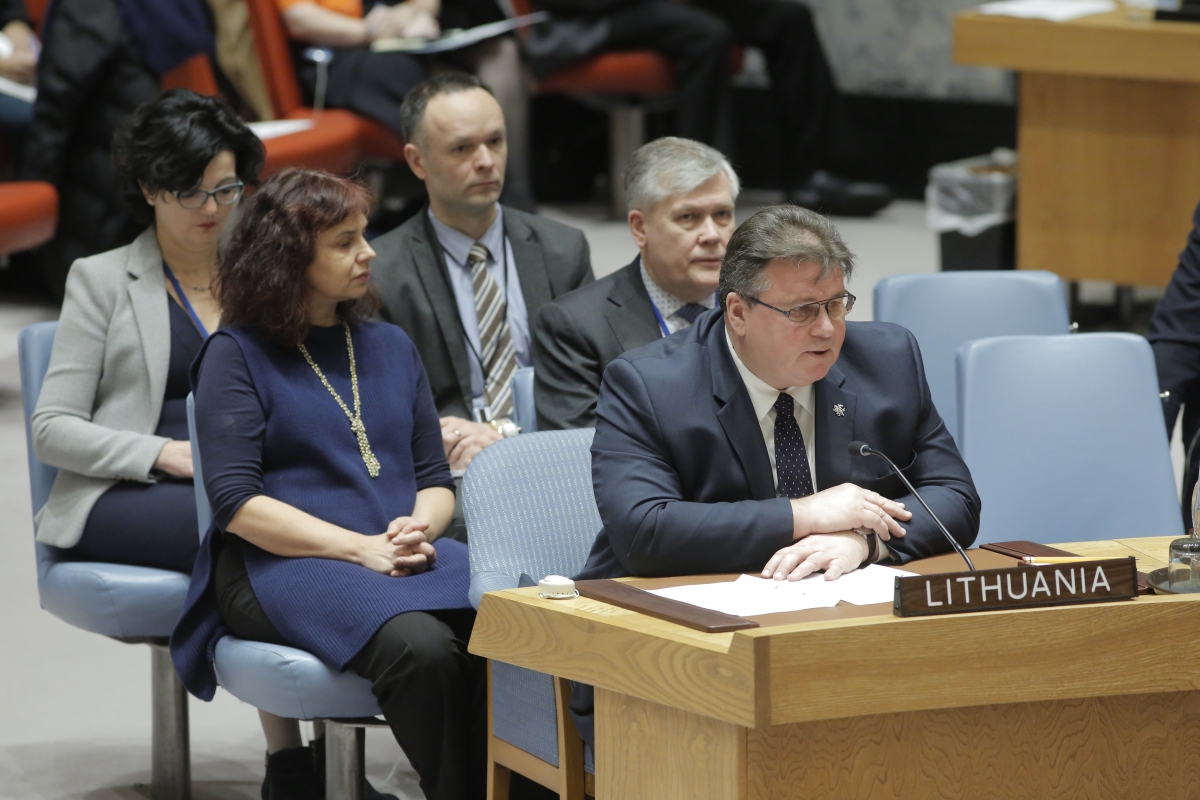
Lithuania's statement at the UN Security Council open debate on conflicts in Europe. Delivered by Minister of Foreign Affairs Mr. Linas Linkevičius
Allow me at the outset to congratulate Mr. Pavlo Klimkin, Minister of Foreign Affairs of Ukraine, on your country’s successful presidency of the Security Council for the month February and for having organized this debate. The theme proposed for discussion today allows us to evaluate current threats to international peace and security posed by the conflicts in Europe and discuss the best ways to tackle them.
Mr. President,
The end of the Cold War, the dissolution of the Soviet Union and the termination of the ideological standoff that had divided Europe for almost five decades evoked the expectations of the new era in the European security. However, today’s Europe is neither free from confrontation nor at peace. Frozen conflicts in Moldova‘s Transnistria and Nagorno-Karabakh region, military intervention in Georgia, increasing influence in the Western Balkans, agression against Ukraine, with illegal annexation of Crimea – these are not isolated cases but rather a broader pattern of behaviour that one of the founding members of the UN has pursued in its neighbourhood throughout the years, with the aim to redraw European borders.
Mr. President,
With its well established full scale soft-power system, using energy, economic and military levers, Russia continues to hamper the integration of the Western Balkan countries into the Euro-Atlantic structures, attempting to preserve the status quo on the still remaining distrust and animosity between these nations. In Transnistria, Russia defends and at times defines the aspirations of separatist regime and with presence of its own troops threatens neighbouring countries. In Nagorno-Karabakh region, Russia is notably fueling the arms race between Azerbaijan and Armenia, which might once again lead to considerations of military options. With its ongoing creeping annexation of Georgian Abkhazia and S. Osetia and so-called referendums, elections or even changing the names of these occupied regions, Russia once again violates the bedrock principles of the international order.
It is evident, that we should use all existing tools and mechanisms in order to revive seriously stalled negotiation processes and join our efforts to avoid new protracted conflict. This time – in Ukraine, where the unprovoked Russian aggression behind the shoulders of its own supported rebels soon will enter its fourth year with almost 10,000 people killed and over 23,000 injured. The recent indiscriminate shelling of Avdiivka proved that the military confrontation is spreading, endangering many thousands more. We need a serious impetus to the stalled implementation of Minsk agreements, which can be achieved only when Russia withdraws its troops from the Ukrainian territory, and when full control over Ukrainian state border is reestablished.
Mr. President,
To advance the enormous challenges in Europe, the collective action is needed at different levels:
First, we see the United Nations as the key actor of effective multilateralism, as a basis of our international system. We need robust UN, capable of addressing complex global challenges. A close and proactive working relationship between the Secretary-General and the Security Council would contribute to it. In spite of Council’s frequent inaction due to the veto practice, Security Council should pay closer attention to protracted conflicts in Europe because they escalate and therefore threaten the overall stability and security of the region.
Secondly, regional and subregional organizations, such as OSCE and the EU are playing a leading role in the conflict and post-conflict environments in Europe. We highly value the OSCE’s engagement regarding frozen conflicts from Transnistria to Caucasus and ongoing conflict in Ukraine, particularly through Special Monitoring Mission (SMM) and call for unrestricted SMM’s access in the whole territory of Ukraine. We have to rethink the OSCE’s role and engagement in Ukraine, including through possible OSCE security mission for the local elections.
Thirdly, with its enlargement policy EU is playing a significant role in promoting the normalization of relations between Serbia and Kosovo, reconciliation process within Bosnia and Herzegovina, as well as among individual countries of the Western Balkans. In Georgia, the EU Monitoring Mission (EUMM) ensures a long-term international monitoring presence in the country and acts as a key factor of stability. In Ukraine, the EU Advisory Mission for Civilian Security Sector Reform (EUAM Ukraine), with its regional presence in Lviv and Kharkiv is an important tool and must be further strengthened and extended. Finally, the EU has progressively imposed restrictive measures against Russia, including sanctions regime, until the Minsk agreements are not fully implemented.
Therefore, we strongly advocate for comprehensive EU-UN partnership, which would increase the capacity to act and to deliver.
In conclusion,
Two years ago in the same room we comemorated the seventieth anniversary of the United Nations, reflecting on history and reaffirming the strong commitment to the purposes and principles of the UN Charter. Today “Europe whole, free, and at peace“ is not yet a reality. But it remains our flagship. In order to succeed, we need to share the same aspirations and recommit to the principles on which European security is built.
