


Lithuania's statement at the UN Security Council open debate on Middle East
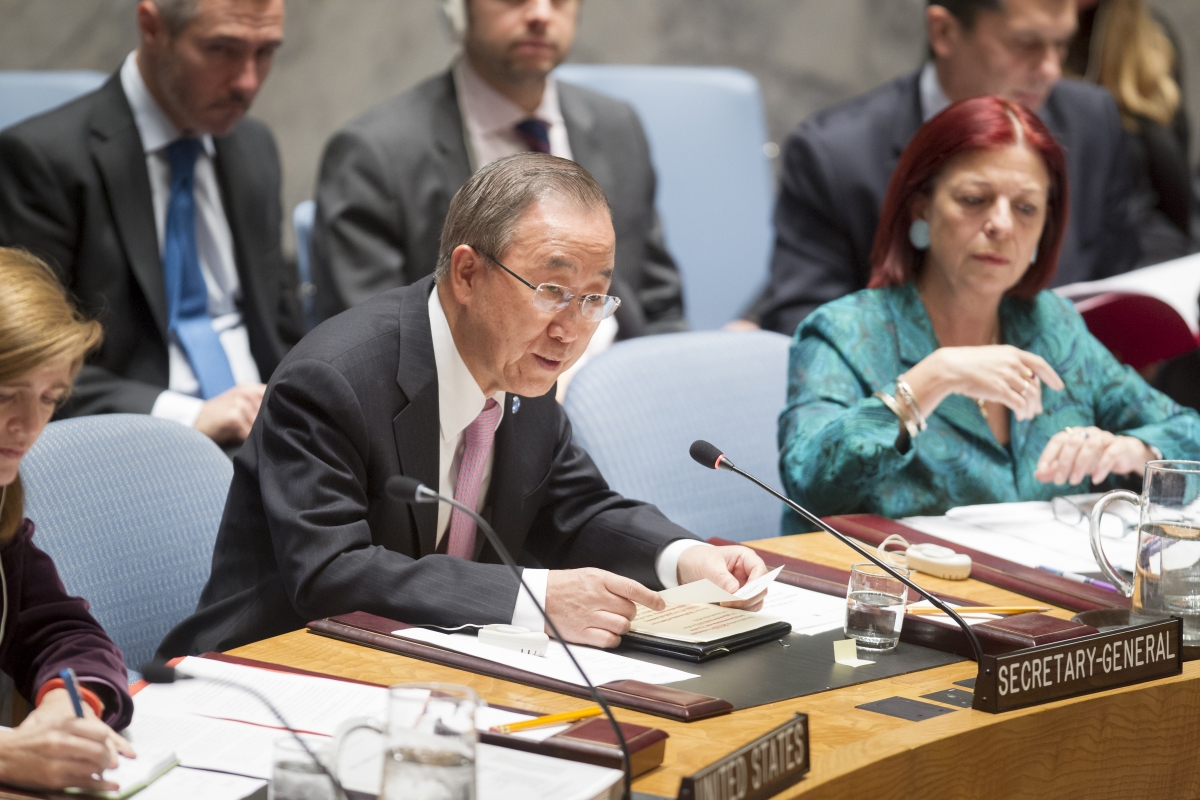
I thank you, Madam President, for convening this Open Debate. I also thank the Secretary General for his briefing. Lithuania aligns itself with the statement to be made on behalf of the European Union. Madam President, The surge of violent extremism has reached unprecedented scope. ISIL and other terrorist groups ruthlessly hijack religion to control territory and vital economic resources. They callously brutalize, kill, and expel all those who don’t accept their rules and beliefs. They abduct, rape and sell to slavery women and children. They target and slaughter minorities.
Only a coherent and coordinated response can tackle what is truly a global and indiscriminate threat. We must all act together to dismantle and destroy ISIL and the likes of it, working in tandem with the countries affected by this plague and in support of the local populations.
We call for a thorough and comprehensive implementation of recent UNSC resolutions 2170 and 2178. ISIL and other terrorist groups in the region must be denied safe havens. All channels of their financing, arming and recruiting must be disrupted. Factors conducive to radicalization and grievances that drive support for such terrorist groups, must be addressed with all due urgency.
The phenomenon of foreign terrorist fighters exacerbates the threat by adding a new dimension to it. Thousands travel from abroad to fuel the conflict. They have little to do with local communities, and they also become tools for the most reprehensible and barbaric acts of terror.
The Security Council has two powerful tools at its disposal, the 1267 and 1373 committees. They were given both – the strategic and practical tasks, within their respective mandates, to tackle the scourge. We look forward to regular updates on their work in that regard.
Madam President,
Iraq has been badly affected by the onslaught of ISIL. The newly elected government of Iraq needs to consolidate and sustain efforts seeking a credible process of reconciliation, overcome past sectarianism and divisiveness. Lessons from previous leaders’ mistakes must be learned quickly. There is no time to lose. The humanitarian situation is dire. We encourage all parties to the conflict to ensure safe, unhindered passage of civilians fleeing the violence and safe access for humanitarian actors to all affected populations. Lithuania has recently made a voluntary contribution through UNICEF, to help the children of Iraq.
The fierce fighting over Kobane has become a symbol of resistance, but also reminded of Syrian government’s refusal to fight ISIL. In the face of ISIL’s expansion, Assad continues to fight its own people, not terrorism. The humanitarian situation in and around Syria, extreme violence and grave violations of basic norms of International Humanitarian Law by all parties to the conflict remain our biggest concern. Access denial, starvation as a method of war, use of chemical weapons and continued barrel bombings of civilian areas constitute war crimes and crimes against humanity. We must make sure that all perpetrators of such crimes will be brought to account.
At the same time we note that without an inclusive political negotiation urgently addressing all legitimate aspirations and grievances of all Syrian people, the situation will continue to deteriorate. We fully support UN special envoy Staffan de Mistura in his efforts and look forward to his briefing of the Council.
Madam President,
Lebanon too is increasingly affected by the situation in the region. In August, the attacks in Arsal reminded of the looming threat of expansionist extremism to this country. Strong democratic institutions are essential to withstand this threat which is affecting the fragile balance among communities in Lebanon. We express our full support to Lebanon, including its armed forces, and call on all parties to put aside their differences and urgently elect a new president. The political vacuum must be filled, in order to strengthen Lebanon’s resilience to dramatic challenges it faces.
In Yemen, the use of force by the Houthis in disregard of the National Dialogue outcomes and the Peace and National Partnership Agreement is a significant blow to Yemen’s peaceful transition. Occupation of civilian and government buildings must stop. Heavy military equipment must be handed over to the government. The unity and territorial integrity of Yemen must be preserved and all political forces should unite behind crucial economic reforms, as further fragmentation will threaten the very survival of Yemen as a state. The Council should no longer hesitate to use the tools at its disposal under Resolution 2140 and impose sanctions on those who are behind the attempts to undermine the peace, security and stability of Yemen.
Madam President,
Turning to the Israeli-Palestinian conflict, we commend Egypt and Norway for convening a conference on the reconstruction of Gaza. Let us hope that this was the last time when the international community was called upon to rebuild Gaza. There cannot be a return to the status quo ante. We need to see a fundamental and durable change in Gaza, within the framework of a two-state solution. The Palestinian Authority must assume its full responsibilities in the Gaza Strip. We are encouraged by the recent PA Cabinet meeting in Gaza. The understanding reached on 25 September was a positive step and should be implemented swiftly and fully.
The government of Israel needs to lift restrictions to the socio-economic development of the Gaza Strip, particularly in the field of movement and access. We welcome the adoption of the tripartite agreement on reconstruction mechanism.
At the same time, we remain concerned by the recent tensions in the West Bank, East Jerusalem, including in Temple Mount/ Haram Al Sharif complex, and a 'price tag' attack on a mosque in the West Bank. The Israeli decision to approve a plan for a new settlement activity in the area of Givat Hamatos is another worrying development.
We call on all parties to refrain from any actions heightening tensions and risking a reversal to an open conflict. We call on the Government of Israel to put an end to its settlement policy in East Jerusalem and in the West Bank. We also call upon the Palestinian leadership to use constructively its UN status.
In conclusion, only a credible resumption of the peace negotiations can lead to a durable solution. Our ultimate objective remains a two-state solution, with the State of Israel and an independent, democratic, contiguous, sovereign and viable State of Palestine, living side by side in peace and security and mutual recognition. Lithuania is fully engaged to this end.
I thank you, Madam President.
