


Lithuania's statement at the UN Security Council open debate on women, peace and security
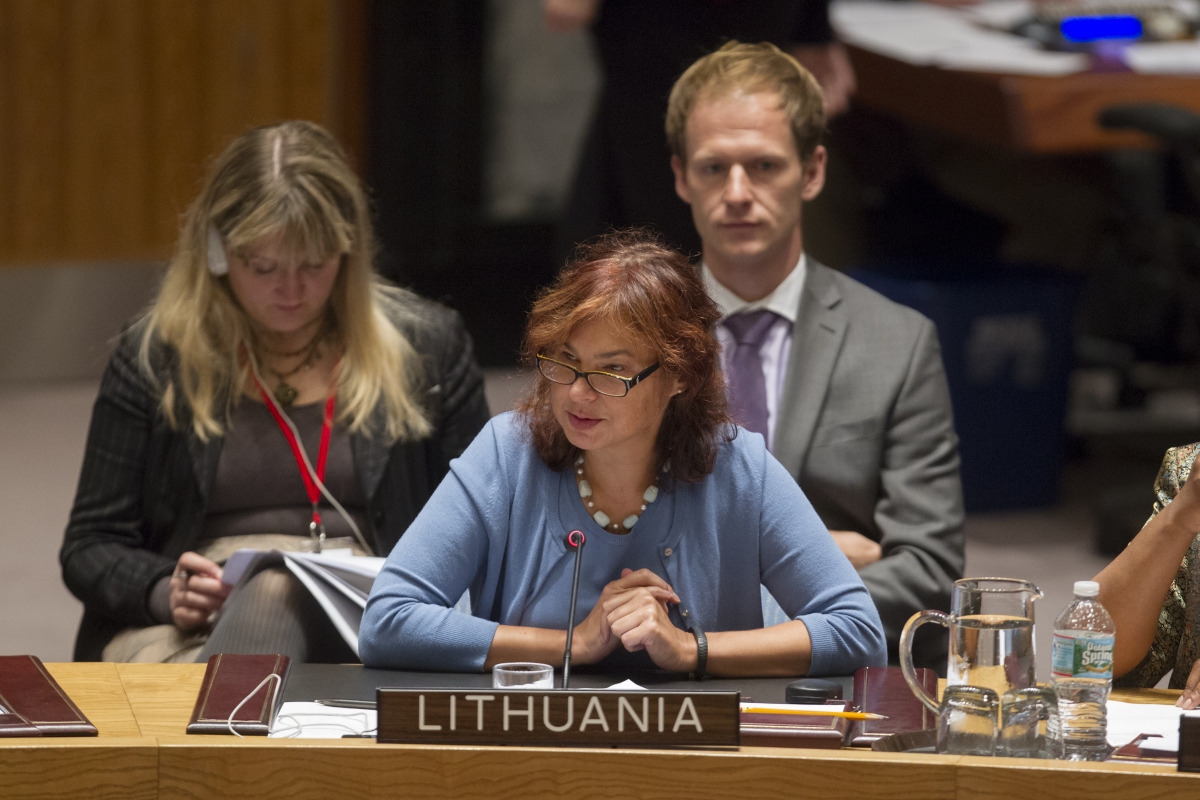
Madam President, We welcome the convening of this open debate by the Argentine Presidency. We thank the Secretary-General for the comprehensive report and the recommendations contained in it. We commend the work and dedication of General, Executive Director of UN Women Ms. Phumzile Mlambo-Ngcuka and her team and thank all the briefers for their valuable contributions today. Madam President, Over 50 million people are displaced around the globe, the worst level of displacement since World War II. Afghanistan, Colombia, DRC, Somalia, Central African Republic, Iraq, Sudan, South Sudan and others have seen massive flight of populations for their lives. Syria, with its more than six million IDPs, is the worst humanitarian crisis of this century. In the middle of Europe, too, forced displacements have peaked because of Russia’s aggression against Ukraine. Accounting for half of those displaced, women bear the physical and psychological brunt of conflict. To many of them, providing subsistence to their families, procuring firewood and water, taking care of basic sanitary needs- every step outside the displacement camps, and even within the camps, is fraught with very real physical dangers, including sexual violence and rape and a heightened risk of sexually transmitted diseases, including HIV/AIDS.
Early and forced marriages stunt the lives of many Syrian girls living in refugee camps. The horrendous practices of forced impregnation, human trafficking, and sexual slavery are shattering countless lives in areas under ISIL control. We are yet to see he release of the Nigerian schoolgirls abducted by Boko Haram. The illicit flows of small arms through porous borders and in defiance of arms embargoes fuel violence and criminality and increase the vulnerability of refugees and IDPs, even in refugee camps and settlements. Women and children are the first victims of such illicit flows, as reminded earlier today by Ms. Suuad Allami.
Madam President,
A number of important documents provide the basis for addressing the problem of displacement. The UN Guiding Principles on Internal Displacement provide an overarching normative framework that applies international human rights and humanitarian law to IDPs. The Kampala Convention, the first of its kind in the world, binds governments to provide legal protection for the rights and well-being of those forced to flee inside their home countries due to conflict, violence, other human rights abuses or due to natural disasters. There’s also the landmark UNSC 1325, whose 15th anniversary will be marked next year, and its follow-up resolutions, including UNSCR 2122 which contains important references to forced displacement and its effects on women and girls.
Yet, as our British colleague has indicated, gaps persist. We need to close those gaps between existing legislation and the reality on the ground. We must continue working to improve gender mainstreaming, by providing gender awareness training to peacekeepers, field staff and humanitarian actors, appointing gender advisors, and developing concrete indicators to assess implementation of gender mainstreaming policies. Gender- disaggregated data is key to better decision making in terms of addressing the needs and concerns of displaced women, as noted earlier today by the Special Rapporteur Beyani.
Even basic improvements such as supporting on-camp provision of cooking fuel or water and integrating women in the design, implementation, and review of distribution systems can literally make a difference between life and death, by reducing their exposure to attacks. Developing leadership skills and capacity of the displaced women is essential to enabling their meaningful participation in decision-making processes at the community level, within camps, in non-camp and urban displacement settings, as well as in the broader political, security, peace and reconciliation processes. Today, only nine per cent of peace process participants are women- that needs to change. As Mrs. Mlambo-Ngcuka stated, empowered women and girls are the best hope for sustainable development following conflict. Existing good practices must be collected and made readily available, including on engaging displaced women in transitional justice processes.
Madam President,
Sexual violence in the context of displacement affects those already most vulnerable. Last week we heard a shocking account of SRSG on Sexual Violence in Conflict Zainab Bangura from her recent visit to South Sudan. Such crimes will continue unabated as long as those who commit them know they will walk free, no matter how many victims they leave behind.
The importance of bringing the perpetrators of sexual crimes against the displaced women and girls to account under national and international law is paramount. A systematic collection of accurate, reliable and objective information by CoIs, fact-finding and HR missions on the crimes committed against displaced women and girls is key to pursuing justice.
We note the significant advancement in international law made by the Rome Statute of the ICC, which includes sexual violence in the definition of crimes, in particular as a crime against humanity. The ICC continues to be an important mechanism in combating sexual violence in conflict and should be used vigorously to pursue accountability.
Greater interactions between the SRSG and sanctions committees, as well as regular inclusion of violence against the displaced women and girls, including sexual violence, as a sanctions designation criterion, would facilitate tackling impunity for such crimes.
Systematic and delicate work needs to be done on the ground to address the social stigma associated with such crimes, and creating an environment where victims of sexual violence will feel safe to speak out.
Providing gender-sensitive training to local police, military forces, judiciary, as well as health care personnel and social workers, in the particular context of displacement, is thus essential. The recruitment and training of female law and order officials and judges, and providing necessary psycho-social support and reparations mechanisms for the displaced women and girls should be further advanced.
On the peacekeeping and field staff side, preventive measures must be part and parcel of pre-deployment training. Zero tolerance policy regarding sexual violence and abuse must be firmly implemented. It is unthinkable that women and girls could suffer sexual abuse from those who are there to protect them. The recent allegations against AMISOM are deeply troubling and must be properly investigated. We welcome the fact that the AU established a panel to this effect.
Finally, while discussing the situation of displaced women, we should also bear in mind non-conflict related displacement, caused by natural disasters and climate change. We need to closely examine the gender dimensions of such displacement, in order to identify specific vulnerabilities and good practices in gender-sensitive protection, assistance, adaptation, mitigation, relocation and reconstruction processes.
I thank you.
