


Lithuania's statement at the UN Security Council open debate on working methods
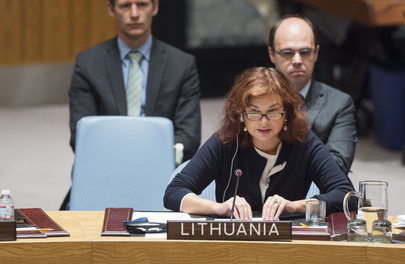
Madam President, I thank you for organizing this debate and your commitment in guiding the Informal Working Group on Documentation and Other Procedural Matters. This year has been one of the most productive in terms of the Notes of the President. I warmly thank the briefers, Mrs. Kimberly Prost and Mrs. Fatou Bensouda. Issues of due process in sanctions regimes and, in particular, of the Council’s follow-up to its referrals to the International Criminal Court have long been discussed in the context of a larger debate of the Council’s role in ensuring accountability and justice.
First, though, I wish to briefly refer to the recent progress in the work of the Council. This year saw the number of public meetings increase by 25 per cent compared to 2013, while the number of consultations remains about the same. Out of ten Council Presidencies in 2014, seven opted for wrap-up meetings. Briefings to UN general membership on the monthly programme of work as well as end-of-month briefings have been common this year. The Council’s website has been further improved. A new SC sanctions-dedicated website was launched, and the use of eRooms has been helpful in managing the flows of information.
Madam President,
While progress continues to be made, there’s still considerable room for further improving the Council’s working methods. First, with regard to how we translate our statements on justice and accountability into tangible pursuit of ending impunity. In this respect, the link between this Council and the ICC demands a fresh look and new ideas. Executing arrest warrants is one of the Court’s most difficult challenges. While the Council has made referrals to the ICC, it has thus far failed to take any action with regard to repeated ICC notifications. That does not speak well for the ability of this Council to enforce its decisions. Whether we can task the Working Group on International Tribunals to tackle these issues, or develop a different mechanism to this effect, we need to address effectively the relationship between the Council and the Court, and also address the issue of follow-up mechanisms.
Second, the Security Council increasingly relies on sanctions regimes as an indispensable tool for the maintenance of international peace and security. Sanctions, whether intended to coerce, constrain, or deter, can only serve their underlying purpose when they are properly targeted. The office of Ombudsperson has proven to be an effective mechanism for improving the credibility of measures taken within the Al-Qaida sanctions regime. A core aspect of such mechanism, its independence, needs to be continuously upheld, including through removal of remaining channels of interference, from various administrative constraints to procedural filters.
Ensuring systematic and consistent application of due process is fundamental. We believe that those targeted under other sanctions regimes should have the same access to mechanisms of redress. We need to reconcile existing inconsistencies between various sanctions regimes, either by extension or replication of the Ombudsperson’s mandate existing under AlQaida sanctions regime, or by application of other mechanisms to the same effect.
Transparency and outreach in the work of the sanctions committees remain paramount. Public briefings to the Council should become a standard, not an exception. Sanctions committees should also be more vocal in sending the message through respective press releases, making sure that those concerned can read them not only in English and French, but also in other relevant languages, such as Arabic in the case of Yemen.
In our view, sanctions committee briefings by the SRSGs on children and armed conflict and sexual violence in conflict, and Special Adviser on the prevention of genocide, as well as exchanges between sanctions committees, panels of experts, and ICC Prosecutor can be very useful and should become a more common practice.
Third, we believe that the structure of the annual report to the General Assembly should be updated in view of the vastly improved UN Security Council website and detailed monthly assessments prepared by all Council Presidencies. Spending 2500 USD per page of the annual report begs the question if this is the best way to spend the always scarce resources, when most of aggregated information is already available on the web. My delegation has submitted proposals to the Working Group on this matter. At the same time, the analytical, thought provoking nature of the annual report needs to be further encouraged.
Fourth, while dialogue between the Council and TCCs and PCCs has improved, one formal annual meeting with the force commanders may no longer be enough. The Council needs to engage with them more regularly, improve the quality of exchanges, especially as we are moving from numbers-based PKO processes to capacity-based planning and a shift in the expectations from and role of PK-ers, and also ensure that there is a meaningful follow-up to such discussions. TCCs/PCCs should be earlier engaged in the force generation process. Regular interim DPKO/DFS briefings on the planning and force generation would enable Council members and TCCs to better address existing gaps.
Lastly, my delegation strongly supports the French initiative on limiting the use of veto, especially in cases of mass atrocities, genocide, war crimes and crimes against humanity. This Council’s failure to take action in preventing the worst atrocities and crimes against humanity is erosive to its credibility. The use of veto thus should be part and parcel of the future deliberations of the Working group. Furthermore, meetings in the Arria Formula as well as horizon-scanning type DPA briefings should be used more vigorously to signal emerging crises and provide sharper focus on situations where populations are at risk of mass atrocities and crimes against humanity.
Before concluding, let me also thank our colleagues from the Accountability, Coherence and Transparency group, as well as non-governmental organizations, such as Security Council Report and others, whose efforts at encouraging transparency and improving the institutional memory regarding the work of the Council serve as a constant reminder to Council members to advance efforts aimed at improving its working methods. A more effective, transparent, and open Security Council is in the interests of the entire membership of the United Nations.
I thank you.
