


Lithuania's statement at the UN Security Council wrap-up session
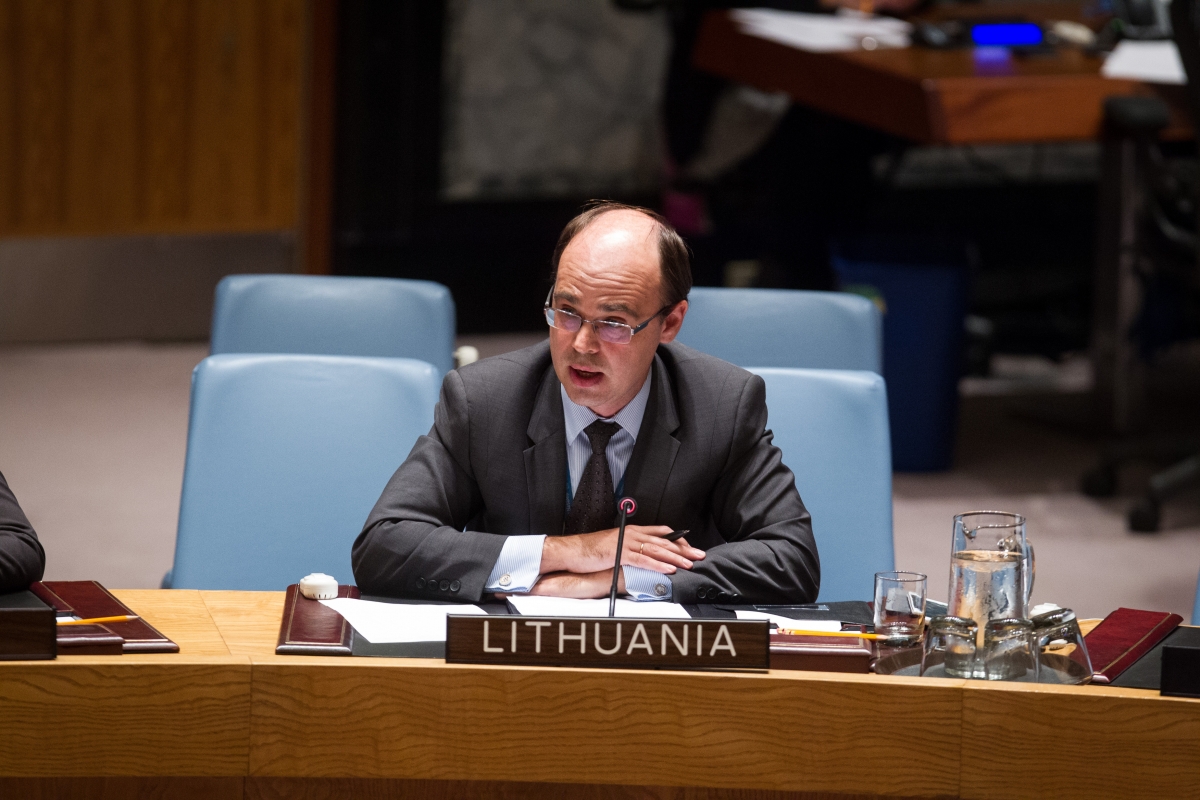
I wish to congratulate you, Madam President, and the Argentinian delegation for the brilliant stewardship of the Council, leadership and successful Presidency in the month of October. We appreciate in particular your dedication to conduct interactive consultations, to read Council’s press statements at stakeout, and blitz tweets before and after Council meetings.
We thank Argentina for holding two important open debates on the working methods and women, peace and security, and the briefing with PKO field commanders. The Council will need to follow up on many ideas that were raised at the meetings.
This month the Council dealt on emergency basis with evolving grave crisis in Yemen, Ebola pandemic in West Africa, persistent ceasefire violations by illegal armed groups in east of Ukraine, and the situation in the Middle East, including settlements in East Jerusalem. In fact, much of the work of the Council on the crisis situations has been the matter of public record this month. This is 15th public meeting this month.
I will therefore focus my remarks on few working methods and important issues that the Council will have to address in the month on November.
The Security Council of 2014 vintage has been setting records for meetings in public. The last few wrap-up sessions, mainstays of privacy not long ago, have been held in the format of the briefing. We note the welcome practice of more and more Chairs of the sanctions committees briefing in public. It has not yet become a golden standard, but surely not an exception. We look forward to your public briefing on the Sudan sanctions, Madam President, in your capacity as Chair of the 1591 sanctions committee. As the Chair of the Yemen and CAR sanctions committees, Lithuania stands ready to brief the Council and the UN membership following any significant developments in committees’ work.
The Council needs to improve the quality of exchanges with DPKO and TCCs, especially as the UN gears up increasingly for capacity-based peace-keeping planning. There must be a meaningful follow-up to such discussions. In October, the Security Council held a frank and timely discussion with the DPKO on UNDOF, UNMISS. We look forward to brainstorming with DPKO on the UN peacekeeping mission in Mali, as UN peacekeepers had sustained many casualties since September in the North of the country. Similarly, we believe we need to pay close attention to the capacity of MINUSCA to meet the challenges in precarious situation in the CAR. We need more systematic implementation of Note S/2013/630 (on consultations with TCC and PCCs) and to continue to build on it. We need to encourage more interactivity when the Council has an opportunity to hear the views from commanders in the field. We look forward to a discussion suggested by Australia with UN police commissioners in November.
We congratulated five new incoming Council members two weeks ago. As the heat and euphoria of elections subsides, important preparations start immediately, in particular preparation for chairmanships of subsidiary bodies on the Council. Lithuania had the task of kick-starting two sanctions committees on Yemen and CAR during the first four months of its Council membership and is ready to share experience with incoming chairs. Beyond that we look forward to an early appointment of chairpersons of subsidiary bodies, in line with note S/2014/393 agreed by the Council 4 months ago.
In November the Council will hear again the briefing by ICC Prosecutor Ms Fatou Bensouda on the relationship between Libya and the ICC. It should not be an occasion as usual. We have counted at least 37 UN member states that took the floor, some of them on behalf of large groups of states, at the open debate on the working methods on the need to address effectively the relationship between the Council and the Court. It is difficult to overlook an overwhelming call for a follow-up mechanism. 9 years have elapsed since the first Council referral. No warrant of arrest has been executed. Do we aim to translate our statements on justice and accountability into tangible pursuit of ending impunity? A follow-up mechanism could contain many elements, such as obligation for all States to cooperate with ICC; designation criteria of sanctions mechanisms; streamlining decision-making by the sanctions committees where Court processes intersect; incentives to prevent failures to co-operation; follow-up forum; financial provision; co-operation of regional organizations; responses to requests and orders from the Court.
In the public meeting on Ukraine on 24 October many Council members called on all participants of the Minsk agreements to immediately implement them in full and work toward a peaceful resolution of the conflict. The Secretary-General deplored the planned holding by armed rebel groups in eastern Ukraine of “elections” on 2 November, in breach of the constitution and national law. We call on the Council members to condemn holding of the so called elections in illegal armed group held areas of Ukraine on 2 November, to call on participants of the Minsk Protocol and the Implementation Memorandum to unequivocally distance themselves from such provocative actions. These "elections" will seriously undermine the Minsk agreements.
To conclude, once again we thank the Presidency of Argentina and congratulate the incoming Australian Presidency, assuring it of our full support.
