


Statement by Lithuania at the UN Security Council Open Debate “Strengthening Maritime Security through International Cooperation for Global Stability”
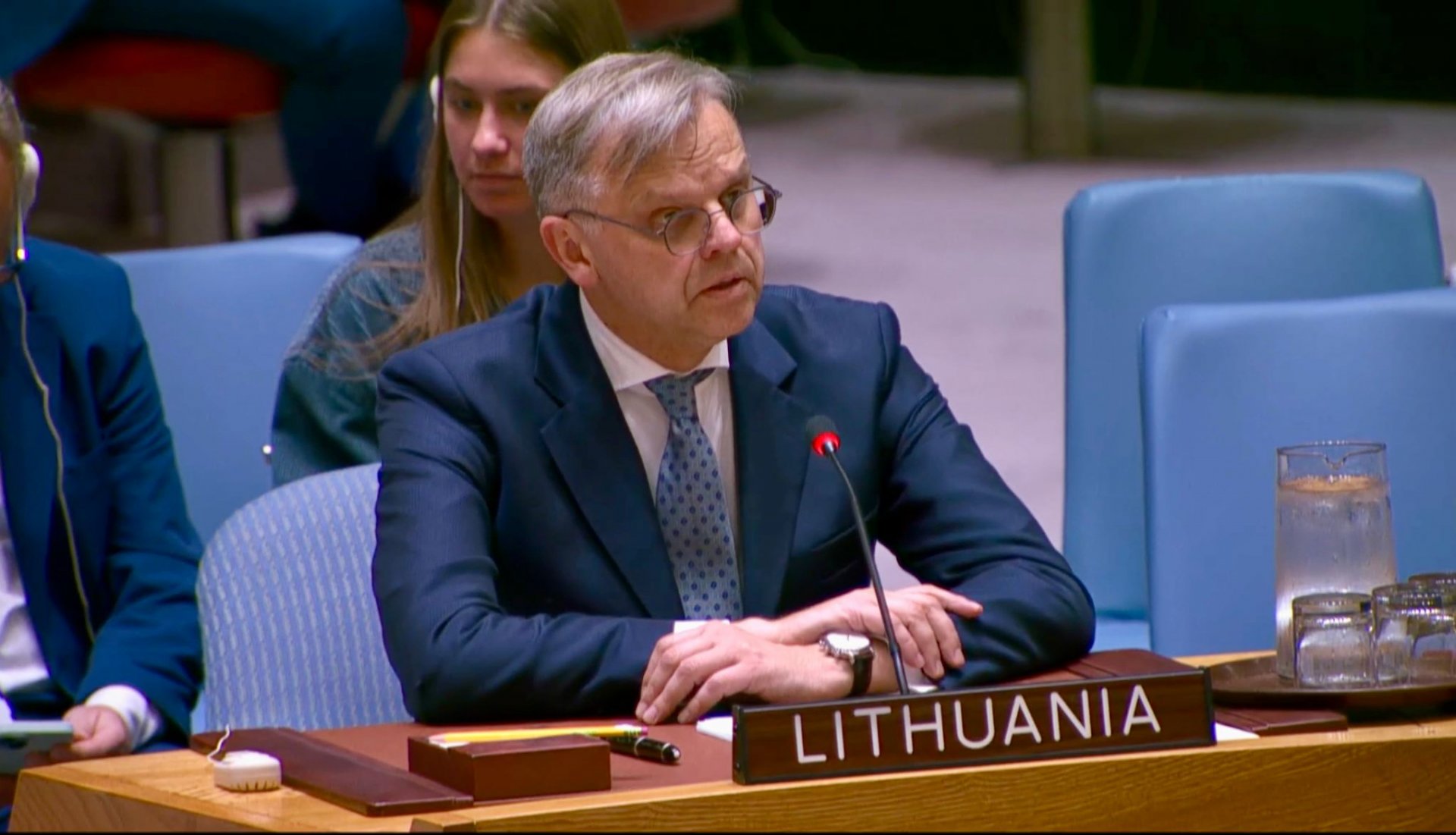
Statement by Lithuania at the UN Security Council Open Debate “Strengthening Maritime Security through International Cooperation for Global Stability” on Tuesday, 20 May 2025.
President,
I appreciate this opportunity to take part in the Security Council open debate on maritime security. Lithuania aligns with the Statement by the European Union. I also will make additional remarks in my national capacity.
At the outset I would like to thank the Greek Presidency of the Security Council for holding this important debate. Indeed, maritime security is strongly tied with multilateralism overall and this debate is very timely.
Today, the Baltic Sea is at the forefront of emerging maritime security concerns. Recent events in Estonia’s Exclusive Economic Zone – where a UK-sanctioned, flagless shadow fleet tanker refused inspection and was escorted by a Russian fighter jet violating Estonian airspace, illustrate this deeply concerning development. Lithuania fully supports Estonia’s steps taken in ensuring maritime safety and security in accordance with international law.
We are also concerned about the seizure by Russia of a Greek owned cargo ship transiting from an Estonian port. This is yet another vivid example of a reckless and provocative behavior by a permanent member of this Council disregarding its own international obligations.
Recently the Baltic Sea region has seen a growing number of Russia’s so-called shadow fleet vessels – ageing, poorly maintained tankers that frequently operate without insurance and are crewed by unqualified personnel. These vessels not only pose significant risks to maritime safety and the environment but also jeopardize the security of undersea infrastructure. Since October 2023 alone, at least eleven undersea cables and one pipeline have been damaged in the Baltic Sea – mostly by shadow fleet vessels dragging anchors on the seabed.
To respond to such incidents, we have taken measures to upgrade our legal framework. As part of our international efforts, in November 2024 Lithuania joined the U.S.-initiated international Joint Statement on the Security and Resilience of Undersea Cables in a Globally Digitalized World.
However, more must be done to address these challenges effectively. The United Nations Convention on the Law of the Sea (UNCLOS) provides a robust legal framework to safeguard underwater infrastructure, but its effective implementation is essential.
Flag states must exercise effective jurisdiction and control over their vessels, ensuring that ships flying their flag do not endanger critical undersea infrastructure. At the same time, it remains open question if flagless ships without clear jurisdiction are fully covered by UNCLOS.
Protecting this critical infrastructure is a shared responsibility. Regarding the shadow fleet, the international community should act to stop the sale and transfer of ageing tankers to opaque or non-compliant entities, as these vessels often end up in shadow fleets that threaten maritime safety and security.
President,
The broader maritime security environment is further strained by Russia’s ongoing aggression against Ukraine in the Black Sea region. Russia has continuously attacked and destroyed Ukraine’s grain export infrastructure in the Black Sea and Danube ports. Russia also has withdrawn from the UN supported Black Sea Grain Initiative and profited from rising global prices on food and fertilizers.
Russia should not be rewarded for weaponizing food. The Memorandum of Understanding between the Secretariat of the United Nations and Russia on promoting Russian food products and fertilizers to the world markets (MoU) should not be renewed. Signed in conjunction with the Black Sea Grain Initiative enabling provision of Ukrainian grain to global consumers the MOU is no longer needed. Its utility for global food supply is questionable, while costs to the UN are sizable.
President,
Maritime security cannot be fully addressed without acknowledging one of its long-standing yet underappreciated threats — munitions dumped on the seabed, including sea-dumped chemical weapons. We note the growing global concern and recognize that the issue of munitions dumped on the seabed transcends environmental protection and becomes a security issue
Since 2010, Lithuania has led international efforts in this regard, initiating the first UN General Assembly resolution on cooperative measures to assess and increase awareness of environmental effects related to waste originating from chemical munitions dumped at sea. The most recent update was adopted unanimously in 2023 and co-sponsored by over 50 countries.
Lithuania is advocating practical steps forward, including exploring modalities for a voluntary database of sea-dumped chemical munitions on dumping sites, types, quantities, and – where possible, the current condition of chemical munitions.
President
Lithuania is a maritime nation, involved in international initiatives underpinning the maritime cooperation, trade and contributing to global food and energy security.
The rapidly evolving “Three Seas Initiative”, to which Greece has recently acceded, opens opportunity for Europe to expand the North-South connectivity axis, providing impetus for multifaceted cooperation and growth. This also enables us to improve transportation links, diversify energy resources and routes, and build resilient infrastructure.
We also call on all Member States to treat maritime security as a matter of shared responsibility — to protect our seas, support science-based decision-making, and uphold international law.
The UN Convention on the Law of the Sea is the legal framework within which all activities in the oceans and seas must be carried out.
We must recognize the important contribution of the Convention to sustainable development as well as to peace, security, cooperation, and friendly relations among all nations.
I thank you!
