


Statement by Lithuania on behalf of the Nordic and Baltic States at the UN Security Council Arria-formula meeting on Human Rights Situation in the Autonomous Republic of Crimea and the city of Sevastopol, Ukraine
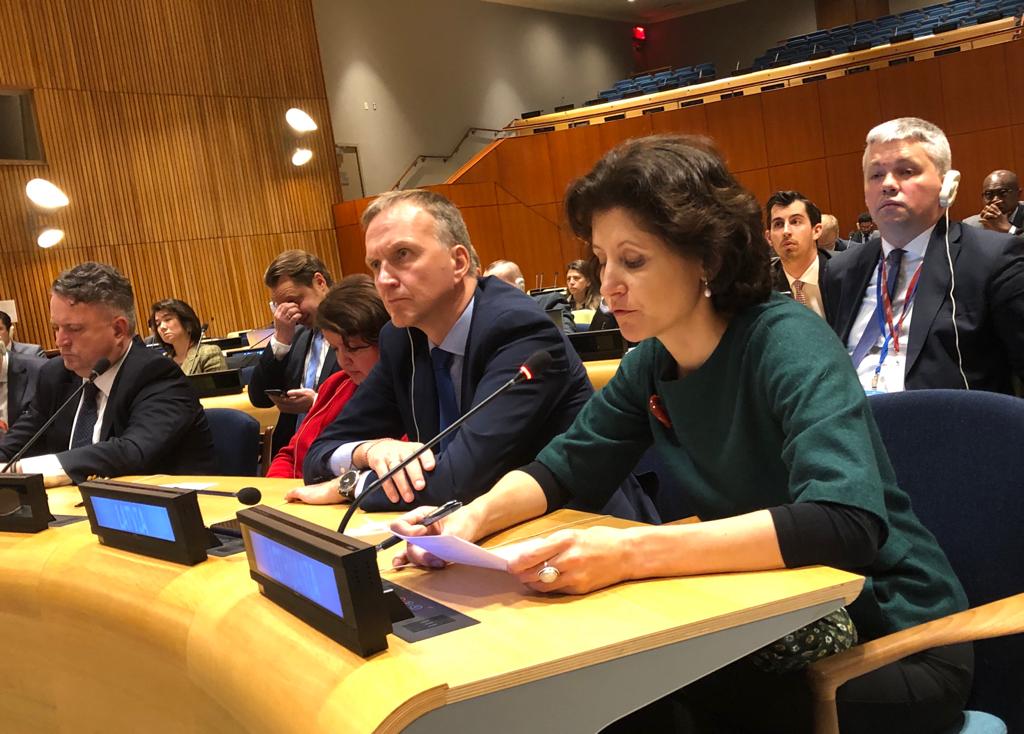
Statement by Lithuania on behalf of the Nordic and Baltic States: Denmark, Estonia, Finland, Iceland, Latvia, Lithuania, Norway, Sweden at the UN Security Council Arria-formula meeting on Human Rights Situation in the Autonomous Republic of Crimea and the city of Sevastopol, Ukraine.
Mr. Chairman, I have the honor to deliver my remarks on behalf of the Nordic and Baltic countries – Denmark, Estonia, Finland, Iceland, Latvia, Norway, Sweden and my own country Lithuania.
We thank the Permanent Missions of Belgium, Estonia, France, Germany, the United Kingdom, the United States and the partner Mission of Ukraine for organizing this timely Arria-formula meeting. The very fact that so many States are present and support this event reflects the degree of political relevance and weight that we at the UN attach to the human rights situation in Crimea and Sevastopol.
I also would like to express a special welcome to Mr. Anton Korynevych, Mr. Refat Çubarov and Ms. Olga Skrypnyk. You provided us with the much-needed factual basis for our discussions here at the UN and – even more importantly – you reminded us how the issues we confront as diplomats affect real people.
Mr. Chairman, as we mark six years since the illegal annexation of the Autonomous Republic of Crimea and the City of Sevastopol by the Russian Federation, the Nordic and Baltic countries strongly reaffirm: Crimea is Ukraine. Our position on the illegal annexation remains consistent: we do not and will not recognize it and continue to implement the non-recognition policy, including restrictive measures.
For the last six years, Russia continued to commit systematic human rights violations in the illegally annexed Crimean peninsula. Russian occupation authorities in Crimea have engaged in persecution of civil society activists, human rights defenders, journalists and other critics of Russia’s actions. We are particularly concerned about violations of the rights of persons belonging to national minorities and other ethnic and religious groups, such as the Crimean Tatar and Ukrainian speaking communities.
The list of systematic violations of human rights in Crimea is overwhelming: the right to the freedom of expression, the right to peaceful assembly and association, the rights to freedom of movement and religion or belief and many more are being constantly violated. Moreover, arbitrary detentions and arrests, enforced disappearances, torture or cruel, inhumane or degrading treatment, intimidation against political opponents and minorities in Crimea, unlawful searches of their homes, physical attacks and baseless systemic terrorism-related prosecutions remain the reality for many residents of Crimea. At the same time, Russia continues to promote policies and conduct practices aimed at changing the demographic structure in Crimea. We recall that the occupying Power shall not deport or transfer its own civilian population into the territory it occupies.
We condemn all violations and actions listed above and call for immediate release of all those who have been unlawfully detained in Crimea. These actions aim to intimidate the people of Crimea, including members of civil society organizations that document abuses on the peninsula and provide humanitarian assistance to the families of victims of politically motivated prosecutions. All human rights violations must be investigated and perpetrators brought to justice.
Mr. Chairman, for the last six years and in spite of numerous requests, the Russian Federation has continuously denied access for the international human rights monitoring missions to prepare dedicated reports on the human rights situation in Crimea, as mandated by the General Assembly in multiple resolutions. The blocking of international scrutiny of the human rights situation in Crimea reinforces the impunity with which the occupying authorities violate human rights and fundamental freedoms. We deplore this refusal and call on Russia to grant proper and unimpeded access to international human rights monitoring mechanisms in order to enable them to carry out their mandate in line with UN General Assembly resolution 74/168.
We are appalled by the attempts of the Russian authorities to silence the information flow and news about Russia’s crackdown on Crimean Tatar human rights defenders by banning independent journalists from entering Crimea. Very recently, journalist Taras Ibragimov was issued with a 34-year-ban from entering Crimea. It is the longest Crimea-related ban that Russia has imposed on a journalist so far. This is simply unacceptable.
Mr. Chairman, the Nordic and Baltic countries reject the notion of the “new normal” in Crimea, despite attempts by the occupying Power to convey such an image to the outside world. The illegal annexation of the peninsula builds on a system of repression and a climate of fear, where anyone perceived as an opponent to the illegal annexation risks persecution. We will continue to support the tireless efforts of the remaining human rights defenders in Crimea.
Finally, we call on the Russian Federation, the occupying Power, to respect, protect and fulfil human rights in accordance with its international obligations. We remain eager to work with the international community to re-establish respect of universal human rights in Crimea, which – regardless of illegal annexation by Russia – is and will remain part of Ukraine.
New York, 6 March 2020
