


Statement by Lithuania on UN GA agenda item 91 “Report of the International Atomic Energy Agency”
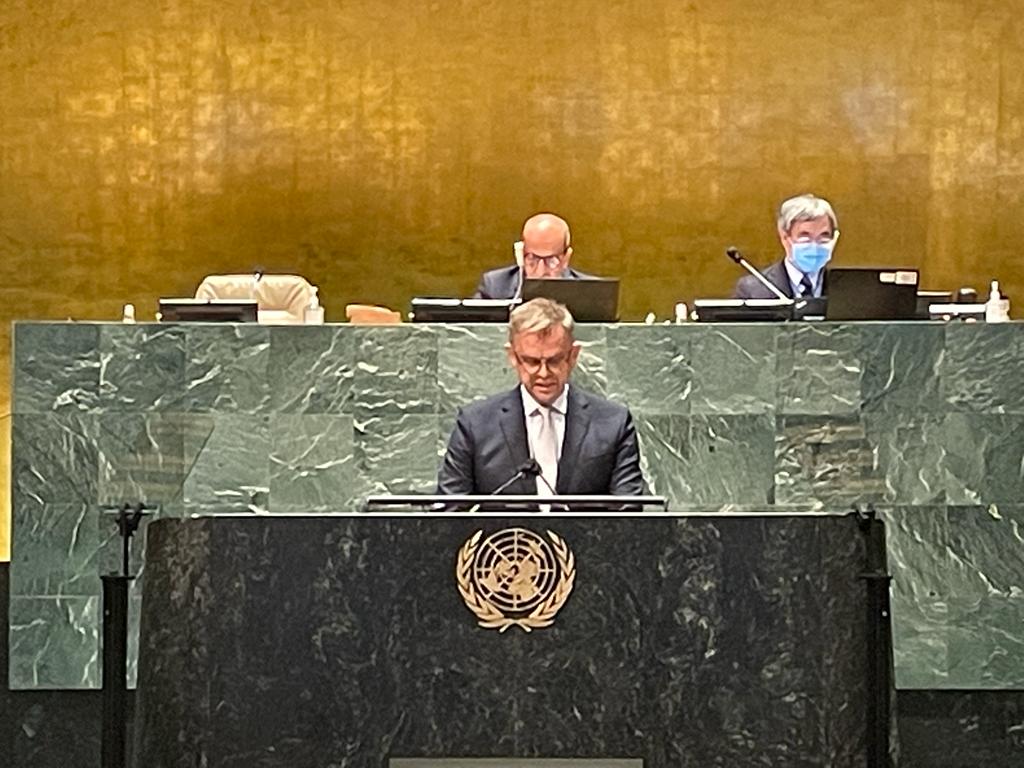
Statement by Lithuania on UN GA agenda item 91 “Report of the International Atomic Energy Agency” on November 17, 2021.
Lithuania fully aligns itself with the statement delivered on behalf of the European Union. In my national capacity, I would like to stress a few more points.
This year the world commemorates 35 years after the Chernobyl and 10 years after the Fukushima accident. At the same time, around 30 countries in the world are considering, planning or starting nuclear power programs, and another 20 or so have at some point expressed an interest. This gives us a clear view that nuclear power will remain extremely important in the global energy mix despite the potential risks that come with it. And with this in mind we have to ensure that nuclear safety is the top priority of every country that has decided to develop nuclear power. Especially, the newcomers to the nuclear power programmes.
When it comes to global nuclear safety, the International Atomic Energy Agency (IAEA) plays the central role – it is the nuclear safety guardian setting standards and providing valuable expertise to its members. We highly value the work done by the IAEA in updating all the safety standards for NPP design and operation. The next crucial step is to ensure that these updated standards become the obligation to all the Member States and with special emphasis on newcomers, instead of just being some nonbinding recommendations.
We have a first-hand example in our immediate neighbourhood – Belarus – how the highly valued brand of the IAEA and its review services are used for manipulative public communication and how a country adopts a declarative and selective approach towards nuclear safety. We are confident that this behaviour undermines support, first of all, by the public to the peaceful use of nuclear energy.
Lithuania condemns in strongest terms the irresponsible decision of Belarus to build the nuclear power plant right on the border with Lithuania (and the EU) and in the immediate proximity to Vilnius – the Lithuanian Capital – without proper evaluation of population distribution and density and without conducting proper consultative process. We maintain that Belarus has not complied with the Article 17 of the Convention of Nuclear Safety regarding the evaluation of all relevant site-related factors and coordination with the neighbouring countries. Up until now, we are trying to get answers from Belarus to the relevant technical questions on site selection; however, the process remains fruitless.
In multiple occasions Belarus has used the IAEA review services to create the visibility of enhancing nuclear safety. E.g., Belarus does not share with the international expert community the peer-review missions’ reports. It does not disclose the progress on the implementation of recommendations. It intentionally limits the scope of the missions to avoid reviewing inconvenient topics, as it happened with the IAEA Site and External Events Design (SEED) mission. The peer-review missions are a very important instrument when it comes to ensuring nuclear safety, so any kind of manipulation in this field is unacceptable. We insist that Belarus publishes all the peer-review mission reports in full, so that the information on identified problems and progress of implementation of recommendations were publicly available.
I cannot but mention two other Conventions adopted under the umbrella of the United Nations Economic Commission for Europe that Belarus has been neglecting – the Espoo Convention on Environmental Impact Assessment in a Transboundary Context and the Aarhus Convention on Access to Information, Public Participation in Decision-making and Access to Justice in Environmental Matters. Quite recently, in October 2021, the Members of the Aarhus Convention have reiterated – for the fourth time – that Belarus was in non-compliance with the Convention. We also have a standing decision from December 2020 within the Espoo Convention, which confirms that Belarus did not justify the selection of the Ostrovets site over the alternative locations.
There are multiple unresolved nuclear and environmental safety issues directly related to the Belarus NPP. This poses unacceptable threat to national security, environment and the public health of the region.
Lithuania retains the position that Belarusian NPP is constructed in violation of international nuclear safety standards and should not be in operation.
We encourage the international community to join the Lithuanian call on Belarus to implement the highest international environmental, nuclear safety and radiation protection standards. We are convinced that the role of the IAEA in ensuring nuclear safety worldwide should be strengthened, alongside with IAEA’s standards and the use of the Agency’s services obtaining a more binding character.
