


Statement by Mr. Trečiokas, Lithuania's Minister of Environment at the high level political forum Ensuring that no one is left behind
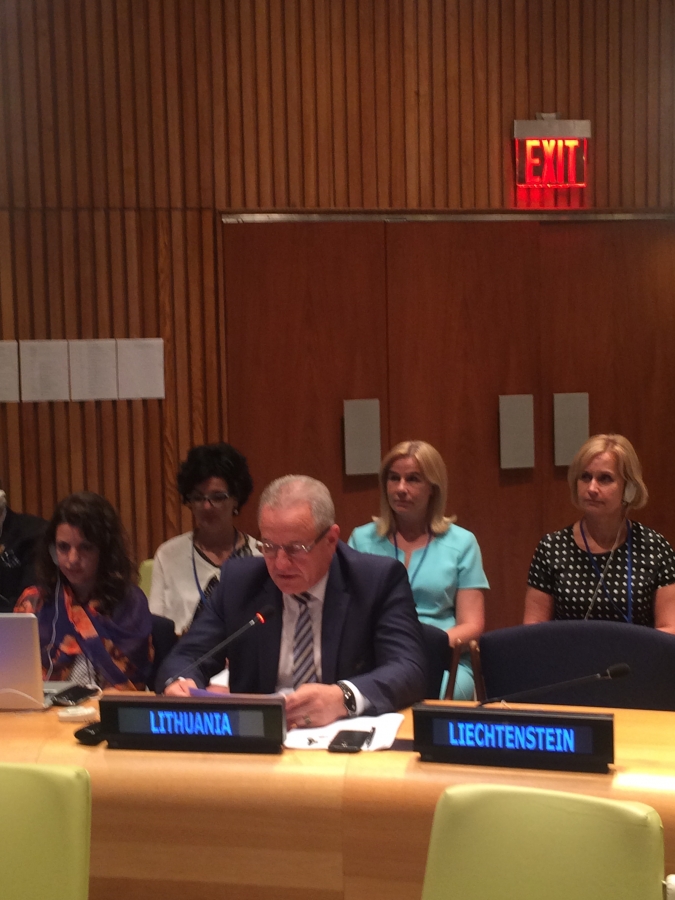
Mr. President, Excellencies, Colleagues, My delegation aligns itself with the statement made on behalf of the European Union. In my national capacity, allow me to underline the following. Agenda 2030, adopted in September last year, offers a roadmap towards a world that is more just, more prosperous and more sustainable for everyone. The effective implementation of this ambitious agenda is our common responsibility and our common promise for the future.
Where conflict reigns, impunity and lawlessness prevail, abuse of power and corruption persist, and human rights violations are routine, ensuring that no one is left behind is a huge challenge, if not a distant dream.
Goal 16 - building peaceful inclusive societies based on the rule of law, access to justice, good governance, corruption-free and accountable institutions - is of fundamental importance to the success Agenda 2030 implementation.
So is ensuring gender equality, or Goal 5, because as we well know, in countries where women are equal participants in all aspects of a society’s life, there's less poverty, more economic growth, and higher standards of living. For example, in my country, women entrepreneurs account for 60 per cent of businesses in rural areas, thus actively contributing to the prosperity and well-being of local communities. Creating a positive business environment which enables to tap the entrepreneurial interest and potential of women is essential for the success of SDGs implementation everywhere.
A successful implementation of the sustainable development agenda also depends on the effective identification and mobilization of resources and the necessary means of implementation, as well as on building strong partnerships, as per Goal 17.
Mr. President,
We all know that sustainable development cannot be achieved unless environmental aspects are not fully taken into account. Sustainable environment plays an important role in lifting people out of poverty, ending hunger, ensuring economic growth, promoting health of our people and of the entire planet.
Actions in key environmental areas such as combating climate change, protecting oceans and water resources, ecosystems and biodiversity, reducing pollution and waste, increasing resource efficiency support the achievement of most SDGs.
Lithuania considers policy integration and coherence as an overarching principle and essential tool which must be used to its full potential at global, regional and national levels. It must be at the core of implementation, capitalizing on the synergies among the SDG and their targets in different sectoral policies.
Lithuanian experience proves that there is no contradiction between environment protection and economic growth. Our greenhouse gas emission levels in the last 25 years fell by more than half while our GDP increased by 30 per cent during this period.
Climate change is recognized as a major threat to sustainable development and ending poverty. To some countries, it even poses an existential threat. Lithuania’s climate change mitigation policy is based on a sustainable development of energy from renewable sources and energy efficiency. In our country today energy production from renewables accounts for more than half of the whole electricity and heat production.
One of the main renewable sources in Lithuania is forest biomass. Forest related SDGs highlight the multi-functionality of forests and their contribution to sustainable development. Thanks to a coherent and consistent national forest policy, forest area in Lithuania has increased by 2 percent during the last 10 years and today covers 1/3 of the country’s territory. The sustainable management of Lithuania’s forests allows us to better address the challenges of climate change and increase the multiple benefits provided by forests to our society.
We have also launched an extensive programme of apartment building modernization as part of our climate change mitigation efforts, aimed at increasing energy efficiency of house heating, and also creating additional jobs and thus contributing to our economy.
These are just a few national examples that show the critical links between the environment, development, and social issues. The interlinkages of all the 17 SDGs mean that progress cannot be achieved without balanced policy integration and coherence at all levels. Our domestic actions allow us to achieve poverty eradication, well-being and healthy ecosystems as well as economic growth.
I believe that ambitious national objectives and political will, engagement of civil society, science community and private sector, together with joint efforts of the international community will lead to effective implementation of the Agenda. All countries have to be responsible – big and small, developing and developed. Even small actions can lead to big changes!
I thank you.
