


Statement by the Ambassador Rytis Paulauskas in the UN Security Council Open Debate on “War in cities: protection of civilians in urban settings”
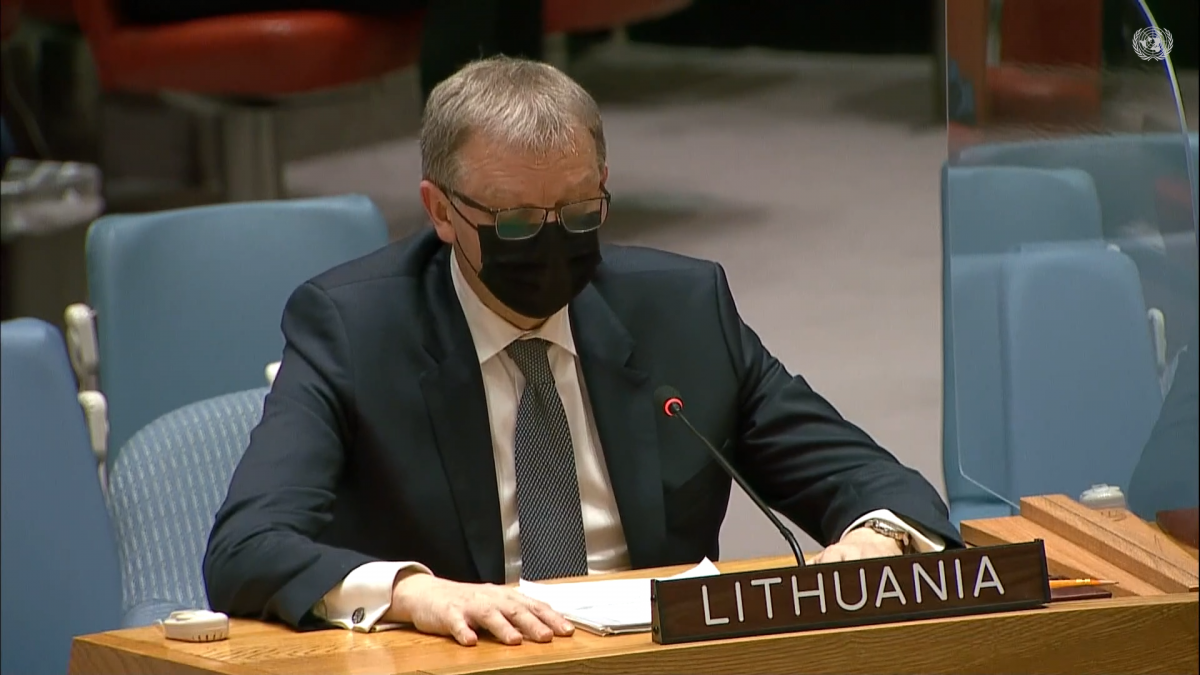
Statement by the Ambassador Rytis Paulauskas in the UN Security Council, Open Debate on “War in cities: protection of civilians in urban settings”, 25 January 2022.
Mr. President,
Lithuania wishes to thank the Norwegian Presidency for holding this important debate.
While Lithuania is in full agreement with the EU statement, I would like to make some comments in my national capacity.
We can all agree that the scourge of urban warfare is a growing problem. Estimates that 50 million civilians worldwide are affected by fighting in heavily populated areas are testament to the challenges faced in upholding IHL across the world. Today, with Russia seemingly set upon escalating its ongoing aggression in Ukraine, this question has a certain poignancy for Europe.
As noted in the EU statement, the responsibility of protecting civilians in cities rests predominantly with those fighting. The particular challenges of combat in urban areas pose severe dangers to those civilians trapped within the city. The international community must be more outspoken in holding combatants up to the standards demanded by IHL. This means condemning violations and finding political and practical solutions to protect civilians and civilian objects, and to ensure that those responsible for any breaches of IHL are held to account.
Special attention is needed to acknowledge the particular vulnerabilities of groups sometimes overlooked. Armed conflicts have a devastating impact on children, they are especially vulnerable to abuse, exploitation and trafficking. Women and girls in places affected by conflict can find themselves subjected to appalling levels of sexual and gender-based violence. They also suffered targeted attacks, intimidation, abduction, forced marriage, and restrictions of movement, based on their sex. People with disabilities are disproportionately impacted and experience even higher levels of risks in war zones.
To date, Russia’s actions in eastern Ukraine do little to inspire confidence. The unwillingness of Russian-backed forces to comply with the principle of distinction there has seen indiscriminate and deliberate shelling resulting in widespread damage to civilian infrastructure and property. Currently almost 4,000 civilians have been killed and 1.5 million people internally displaced.
Russian-backed separatists are using civilian infrastructure as a cover to provoke incidents that can be used to blame Ukrainian troops for attacking civilians and civilian infrastructure. The challenges faced daily by residents in eastern Ukraine or along the line of contact are worth mentioning.
Key infrastructure, such as water pumping stations that serve millions of people continue to be exposed to shelling, entire villages have been without electricity for weeks.
Mines and unexploded ordnances are an additional layer of risk for people living close to the line of contact. Too many families have lost loved ones or seen them severely injured, while they were working in the field, going to school or simply playing in the yard.
Thousands of people, civilians and those fighting, have been killed or injured over the course of the conflict, which continues to claim new victims. Hundreds of people are still searching for their missing family members.
People and communities are suffering. Any intensification of hostilities is affecting their wellbeing and draining their livelihoods. More than 7 years of shooting and explosions leave both children and adults scarred, afraid and worried what tomorrow will bring. Despite all the diplomatic efforts, Russia further escalates and continues military deployment around Ukraine’s borders and in Crimea. Moreover, Russian troops are deployed in Belarus as well. So we find ourselves on the eve of another potential invasion discussing how best to avoid such tragedies. Clearly it is up to the international community to call out such breaches of IHL even when it is a member of the Security Council that is fuelling the concerns.
Cooperation between development and humanitarian sectors as well as support for humanitarian actors in the early stages of a conflict in addressing the critical needs of the population can do much to ameliorate the immediate emergency and may even positively affect the direction of conflict. Lithuania remains committed to strengthening the capacity of humanitarian actors to better prepare and respond to emergencies, in particular conflicts within an urban setting.
I thank you, Mr. President
