


Statement of the Viceminister of Social Security and Labour of the Republic of Lithuania Mr. Gintaras Klimavičius at 59th session of the Commission on the Status of Women
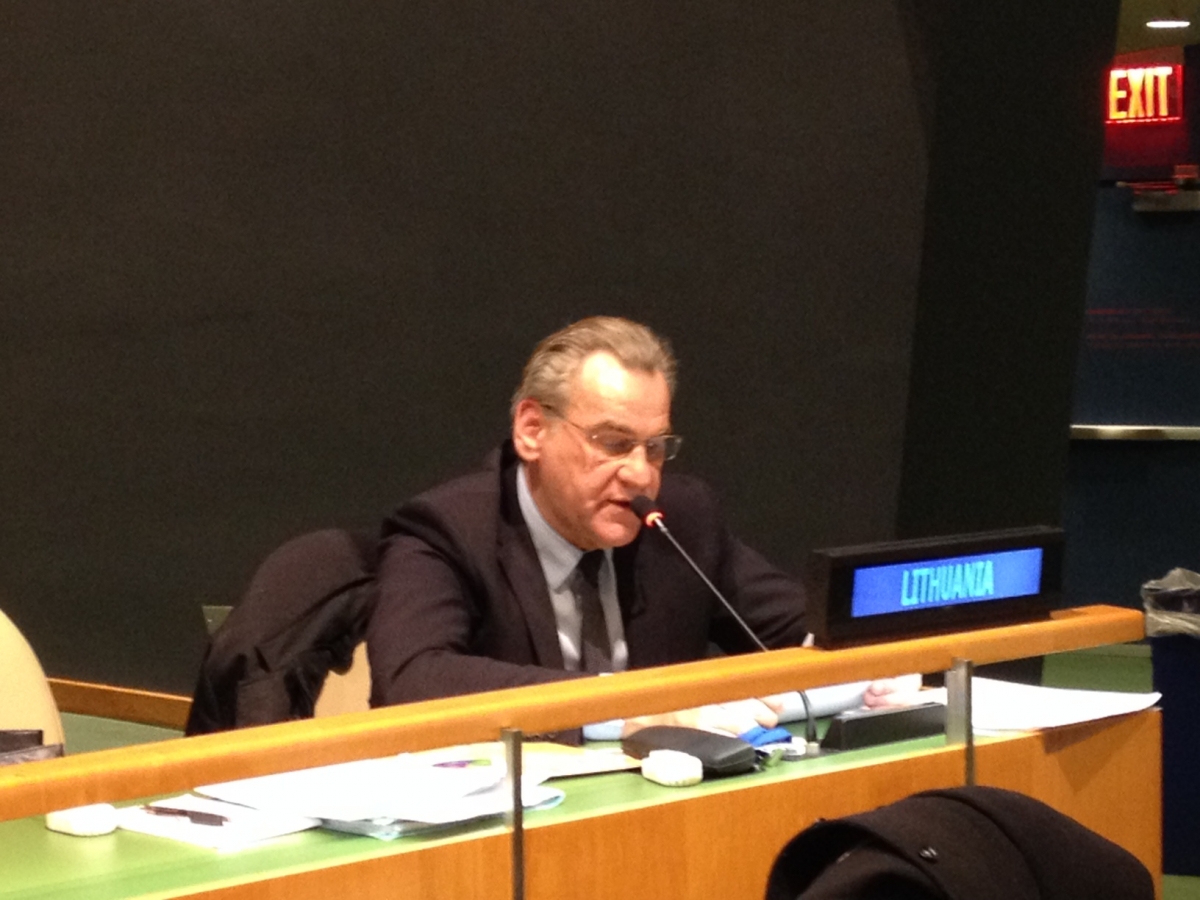
Madame Chair, Ministers, distinguished delegates, Lithuania aligns itself with the Statement made on behalf of the European Union. We reaffirm the commitment to further advance our activities towards full and effective implementation of the Beijing Declaration and Platform for Action and Outcomes of the twenty third special session of the UN General Assembly.
The main objectives of the twelve critical areas of Beijing Platform for Action as well as recommendations of the Committee of Elimination of Discrimination against Women, provided following the consideration of relevant reports of Lithuania, have been incorporated into national legislation and strategic documents and policies. One of the most important our strategic documents in this area is the long-term National Programme on Equal Opportunities for Women and Men. The programme is based on gender mainstreaming approach and is aimed at systematic implementation of gender equality in all areas. Taking into account the results achieved and assessment of remaining gender gaps, the new updated programme was adopted by the Government of Lithuania just a month ago. Main priorities of the programme are: promotion of equality in employment and the labour market, balanced participation in decision making, gender mainstreaming initiatives and strengthening effectiveness of institutional mechanisms.
Consistent and systematic long term implementation of gender equality policies and concrete measures, close cooperation, coordination of actions and synergies of all relevant stakeholders led to a number of concrete results. The gap between employment rates of women and men is almost closed – only 2 percent, when women’s unemployment rate is lower than men’s by 3 percent. Average gender pay gap in Lithuania decreased to 13.3 percent and it is lower than the EU average (which is about 16 percent). Women become more and more actively engaged in entrepreneurship, especially in small and medium-sized business, in particular in rural areas. Higher women’s participation in political and economic decision making is obvious, although there is still room for improvement. Women’s education rate was and remains higher than men’s. It is worth mentioning that women account for over 60 percent of university graduates in Lithuania. Number of women managers reached 39 percent while they comprise about 70 percent in public administration, over 60 percent in the political confidence positions and almost half in diplomatic service. Women comprise the vast majority of judges, notaries, and almost half of prosecutors. Lithuania is one of the countries where 2 out of 3 highest positions are taken by women since 2009 – the President and the Speaker of the Parliament are women. At the same time, last fall the President of Lithuania was elected as President of the Council of Women World Leaders.
Lithuania actively participates in the EU and international gender equality activities, shares Lithuanian experiences and good practices with non-EU member states, in particular Eastern partnership countries, investing in gender equality in development cooperation and so contributing to further promotion of gender equality. Lithuanian representative was recently elected as a Vice-chair of CEDAW.
Following Lithuanian experience we would like to note that the effectiveness of practical implementation of the equality between women and men requires good governance, including well functioning institutional mechanisms, sufficient human and financial resources. Therefore Lithuania supports the initiatives towards better governance, strengthening the effectiveness of institutional mechanisms for accelerating substantial and sustainable gender equality.
Madame Chair,
The year 2015 is unique by its coinciding agenda – this year we commemorate not only the 20th anniversary of the Fourth World Conference on Women, held in Beijing in 1995, but also 15 years passed since the adoption of the Security Council resolution 1325 and Post-2015 Development Agenda is under preparation.
The implementation of the Security Council resolution 1325 is important worldwide. Women, as equal partners, should play the pivotal role in conflict management, conflict resolution, and sustainable peace. Preparations for the 2015 High-level Review of the implementation of the resolution 1325 and the Global Study provide us the opportunity to build on good practices, accelerate and generate new actions and address challenges we face. We believe that sustainable peace requires an integrated approach based on coherence between political, security, development, human rights, including gender equality, rule of law and justice activities.
Today, while celebrating remarkable anniversary of Beijing + 20, we assess the progress made. But further efforts towards de facto equality between women and men are needed in a number of areas until the gender gaps are closed. Gender equality is not just women’s issue. It is also men’s issue and further progress on the matter will benefit both men and women, and our societies as a whole.
Thank you, Madame Chair.
