Lietuvos pasisakymas JT Saugumo Tarybos brifinge dėl JT taikos palaikymo operacijų (anglų k.)
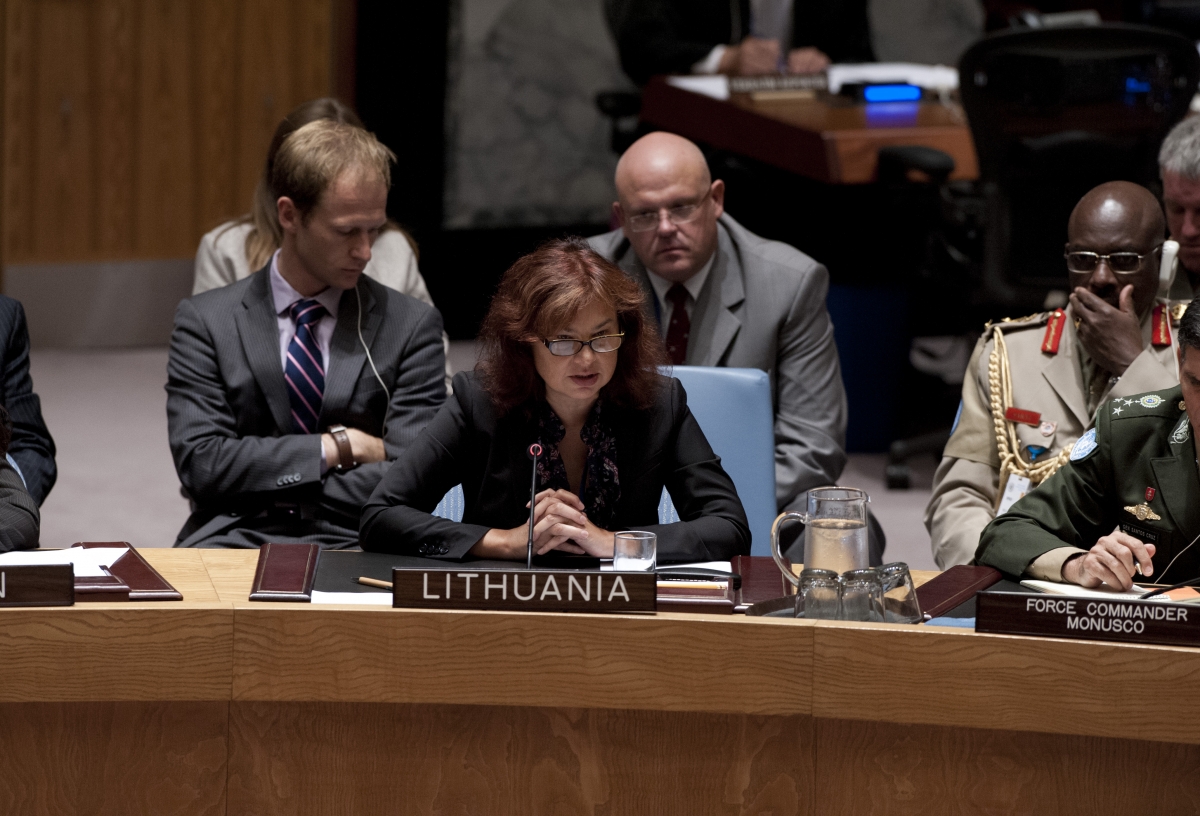
Spalio 9 dieną Niujorke vyko Jungtinių Tautų Saugumo Tarybos brifingas dėl JT taikos palaikymo operacijų. Prisegtuke - Lietuvos pasisakymo tekstas (anglų kalba).
Madam President,
I would like to thank Under-Secretary-General Ladsous, as well as Lieutenant General dos Santos Cruz, Major General Kazura and Lieutenant General Singha for their briefings.
Lithuania welcomes this yearly opportunity to hear from UN force commanders on the most pressing challenges in today’s peacekeeping. We value the frank and direct nature of this conversation, conveying concrete proposals based on actual experience on the ground. We would also like to use this opportunity to express our appreciation of your service under increasingly demanding and challenging circumstances. On your sound judgement hinges the successful implementation of mandates, and also the lives of the peacekeepers and those they seek to protect.
Let me briefly touch upon the three topics selected for today’s discussion.
Fifteen years after the Security Council pledged to systematically address the protection of civilians in armed conflict, civilians continue to account for the majority of casualties in armed conflicts. A gap persists between ambitious normative frameworks and tragic realities on the ground. The most vulnerable groups are often those least protected. In this context we recognise and support all initiatives aimed at enhancing the protection of civilians by UN peacekeepers.
An increased presence of MONUSCO troops in the east of the Democratic Republic of the Congo has had a deterrent effect against armed groups that target civilians. Yet presence alone may be insufficient. Peacekeepers must be ready to demonstrate their willingness to act robustly, quickly and effectively to protect civilian lives.
MONUSCO’s efforts to improve its early warning and response mechanisms should be noted. The establishment of hotlines to alert about impending danger, as well as the Mission’s support for implementation of local protection plans through community protection committees all contribute to reducing threats and insecurity of the civilian population and should be considered in other peacekeeping operations. Last but not least, we strongly support “one mandate, one mission, one force” approach, as saving human lives is the primary task of all units of the mission.
Turning to expectations from the military components, it is important to recognise that the current peacekeeping environment is marked by constantly changing challenges. Peacekeepers face indirect fire, improvised explosive devices, ambushes, and even direct attacks as they carry out their mission in hostile environments. They also find themselves in situations where there is no peace to keep, while peace enforcement may not be in their mandate. In spite of the mantra like repetition by this Council of its resolve to give the operations clear, credible and achievable mandates, matched by appropriate resources, situations continue to occur where the ambition contained in the mandate and the capacity to carry out that mandate are at odds with each other.
Lack of adequate training, proper equipment or enablers, as well as insufficient backing by air assets and modern technologies to counter both conventional and asymmetric threats is a recurrent problem. Such a mismatches end up being a lose - lose situation for all. The UN loses its credibility, civilian population suffers casualties and conflict gets more entrenched, and far too many peacekeepers lose their lives in the line of duty.
In Mali, for example, delays in the deployment of MINUSMA and continued lack of air mobility limited the Mission’s ability to effectively implement the mandate. The situation was further affected by the inability of some TCCs to comply with UN standards. On the other hand, the current steady increase in the Mission’s military and police capacities, as well as enhancing its situational awareness through the establishment of the All Sources Information Fusion Unit are significant steps forward, which have a noticeable positive impact on the protection of civilians.
At the same time, we must acknowledge that MINUSMA no longer operates in the peace-keeping context and that some TCCs bear a disproportionate share of the impact, as tragically reminded by the recent deaths of its peacekeepers. Some discussions on the mandate might be helpful, and the international community should continue contributing to the development of national capacities. In this context, it is essential to note the work of the EU Training Mission whose personnel, including 4 Lithuanian trainers, are engaged in rebuilding the Malian armed forces. The civilian EUCAP mission complements these efforts by supporting internal security forces through training and strategic advice.
Finally, on the accomplishment of traditional mandates under the changing political-military setting, it is crucial to note that the safety and security of peacekeepers must be among the Council’s top priorities when designing or adjusting peacekeeping mandates. It should engage in constant dialogue with the Secretariat and the troop contributors to make sure that peacekeepers are not left to fend for themselves in a dramatically changed environment.
During the recent months in the Golan, UNDOF troops, mandated to observe the 1974 Disengagement Agreement between the Israeli and Syrian forces, were sieged, attacked, forced out of their positions and detained by the designated terrorist groups and armed non-state actors. There can be no justification for such actions, and the perpetrators must be brought to justice. A temporary adjustment of UNDOF’s posture and operations, as well as its immediate relocation, was fully warranted and we commend the mission for continuously reviewing and updating its contingency plans. We are also looking forward to the update from the Secretary General on the steps needed to maintain UNDOF’s ability to implement its mandate.
Before concluding, let me put forward a few questions to the participating force commanders:
1. To what extent pro-active reconnaissance and intelligence helps creating better awareness and, thus, prevents and pre-empts threats? Could you refer to good practices in current peacekeeping operations? What more needs to be done?
2. How “robust” mandates translate into operational plans? Would you rather see the mandate’s tasks to be detailed and precise or leaving a room for Commander’s decision to act for achievement of end states?
3. What is the impact of modern technologies, such as Unmanned Aerial Systems, in today’s peacekeeping operations, in particular on intelligence gathering? Would you suggest deploying these systems to other missions, such as UNDOF?
Thank you.