AMBASADORĖS R.MURMOKAITĖS PASISAKYMAS KONFERENCIJOJE SVEIKATOS IR APLINKOSAUGOS KLAUSIMAIS "KURIANT TVARUMĄ"
Statement by Permanent Representative of the Republic of Lithuania Raimonda Murmokaiteat the 21st International Conference on Health and Environment„Creating Sustainability“ECOSOC Chamber, 3 December 2012 Madam Chair, Thank you for the invitation to this conference on creating sustainability. Every human being has the fundamental right to be free from hunger, according to international human rights law. And yet today, as the FAO State of Food Insecurity in the World 2012 report indicates, close to 900 million people still suffer from hunger. Recent UNICEF research indicates that some four million young children die each year—more than 10,000 per day—due to hunger, malnutrition, and unsafe drinking water. The idea of resource shortage as a cause of conflict, including hunger or water wars, is not a mere theoretical conjecture. Resource and food shortages threaten political stability, social welfare and economic growth. This makes universal food security a critical issue. At the Rio+20 meeting in June this year the world leaders discussed a wide range of issues, including sustainable agricultural development, food security and poverty. We must rethink how we grow, share and consume our food - while at the same time protecting the environment and our soil, water resources, forests, and biodiversity from degradation and irreversible damage, and maintaining a focus on addressing climate change. To succeed in tackling the issue of global food security, we must build on existing achievements and best practices; rely on scientifical findings and technological innovations; and change our patterns of consumption and our approaches to sustainability as a whole. Cutting on food waste alone would enable us to feed about half of those suffering from chronic malnutrition today without additional pressure on natural resources. Madam Chair, The Secretary General’s High Level Global Sustainability Panel notes that “Democratic governance and full respect for human rights are key pre-requisites for empowering people to make sustainable choices.” Past experience contains dire warnings of what happens in the absence of good governance, democracy, and the rule of law, and how access to resouces can be manipulated for political ends. Eighty years ago the people of Ukraine had suffered one of the great tragedies of the twentieth century – the Holodomor, a mass starvation caused by the deliberate actions and policies of Stalin’s regime. While the grain was shut away in barns for export, millions of people were dying from hunger as Stalin’s plans of mass collectivization of agriculture were mercilessly forced upon the rural population in Ukraine. We share with Ukraine and other affected nations their sorrow and a deep apprehension of tragedies caused by totalitarian regimes. The memory of the tragedy of Holodomor resounds strongly in our hearts- also because it evokes our own people’s suffering caused by forced Soviet collectivization, when multiple families were deported to Siberia just for being successful private farmers, agronomists or entrepreneurs- in order “to liquidate the kulaks as a class”- and once in exile, were later re-exiled from one place to another, for having preserved their industrious spirit even under such inhuman conditions. The past cannot be changed. But the truth must be spoken. The memory of Holodomor victims must be kept alive. It must be a source of strength in the face of oppression and injustice, reinforcing our resolve to protect and uphold human rights, and to promote democratic governance and the rule of law as we move towards the implementation of the MDGs and the post-2015 agenda. Redoubling our efforts aimed at creating a world where no one will have to go hungry or fear for one’s life is paramount to preventing human tragedies of a similar scale in the future. This is the least we can do to commemorate the victims. I thank you, Madam Chair.
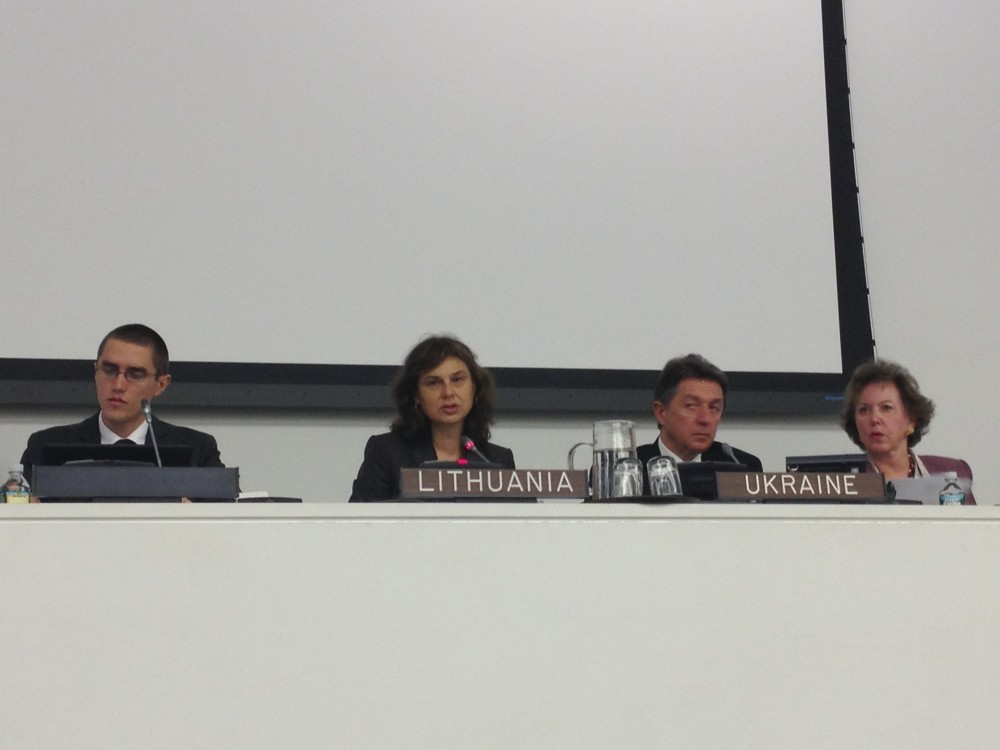
Statement by Permanent Representative of the Republic of Lithuania Raimonda Murmokaite
at the 21st International Conference on Health and Environment
„Creating Sustainability“
ECOSOC Chamber, 3 December 2012
Madam Chair,
Thank you for the invitation to this conference on creating sustainability.
Every human being has the fundamental right to be free from hunger, according to international human rights law. And yet today, as the FAO State of Food Insecurity in the World 2012 report indicates, close to 900 million people still suffer from hunger.
Recent UNICEF research indicates that some four million young children die each year—more than 10,000 per day—due to hunger, malnutrition, and unsafe drinking water.
The idea of resource shortage as a cause of conflict, including hunger or water wars, is not a mere theoretical conjecture. Resource and food shortages threaten political stability, social welfare and economic growth. This makes universal food security a critical issue.
At the Rio+20 meeting in June this year the world leaders discussed a wide range of issues, including sustainable agricultural development, food security and poverty.
We must rethink how we grow, share and consume our food - while at the same time protecting the environment and our soil, water resources, forests, and biodiversity from degradation and irreversible damage, and maintaining a focus on addressing climate change.
To succeed in tackling the issue of global food security, we must build on existing achievements and best practices; rely on scientifical findings and technological innovations; and change our patterns of consumption and our approaches to sustainability as a whole.
Cutting on food waste alone would enable us to feed about half of those suffering from chronic malnutrition today without additional pressure on natural resources.
Madam Chair,
The Secretary General’s High Level Global Sustainability Panel notes that “Democratic governance and full respect for human rights are key pre-requisites for empowering people to make sustainable choices.”
Past experience contains dire warnings of what happens in the absence of good governance, democracy, and the rule of law, and how access to resouces can be manipulated for political ends.
Eighty years ago the people of Ukraine had suffered one of the great tragedies of the twentieth century – the Holodomor, a mass starvation caused by the deliberate actions and policies of Stalin’s regime.
While the grain was shut away in barns for export, millions of people were dying from hunger as Stalin’s plans of mass collectivization of agriculture were mercilessly forced upon the rural population in Ukraine.
We share with Ukraine and other affected nations their sorrow and a deep apprehension of tragedies caused by totalitarian regimes. The memory of the tragedy of Holodomor resounds strongly in our hearts- also because it evokes our own people’s suffering caused by forced Soviet collectivization, when multiple families were deported to Siberia just for being successful private farmers, agronomists or entrepreneurs- in order “to liquidate the kulaks as a class”- and once in exile, were later re-exiled from one place to another, for having preserved their industrious spirit even under such inhuman conditions.
The past cannot be changed. But the truth must be spoken. The memory of Holodomor victims must be kept alive. It must be a source of strength in the face of oppression and injustice, reinforcing our resolve to protect and uphold human rights, and to promote democratic governance and the rule of law as we move towards the implementation of the MDGs and the post-2015 agenda.
Redoubling our efforts aimed at creating a world where no one will have to go hungry or fear for one’s life is paramount to preventing human tragedies of a similar scale in the future. This is the least we can do to commemorate the victims.
I thank you, Madam Chair.